













25–26 February 2027 | Vancouver
Canada's summit dedicated exclusively to communicators navigating AI is back for 2027 — after a sold-out 2026 debut.
Your CEO wants an AI strategy. Your team is quietly experimenting with tools nobody's approved. Your audience is more skeptical of synthetic content than ever. And somewhere in your inbox is a headline about a brand that got it catastrophically wrong.
You don't need another AI hype session. You need a room full of people who are solving this exact problem, right now, inside organizations as complex as yours — and two days to walk away with a plan instead of more anxiety.
That's what this summit is for.
Our 2026 edition sold out weeks before the event — hundreds of comms leaders from across Canada packed the room because nothing else like it existed. For 2027, we're back with a completely new lineup, sharper topics, and the same capacity-limited format that made last year's edition sell out fast.
If you're waiting to decide, know this: last year's late registrants missed out entirely.
This isn't a stage full of AI vendors pitching you software. It's senior communicators and strategists who've had to make these calls inside real organizations:
Not slides. Not inspiration. Actual answers to the questions your leadership is already asking you:
25–26 February 2027 · Vancouver, BC
Registration is open now, with seats capped to keep the room working sessions, not a stadium crowd. Last year, that meant a sellout weeks in advance.
AI strategy works best when your whole team hears it together — and plans together on the flight home. Group discounts are available for the AI in Comms Summit. If you're sending two or more delegates, get in touch with Don HERE to learn more about special rates and packages for teams.
 Brochure download
Senior Digital Communications Advisor, Canada’s Minister of AI and Digital Innovation
Institut québécois d’intelligence artificielle (Quebec Artificial Intelligence Institute)
Board Member at Online News Association and Canadian Association of Journalists
As AI tools grow more capable, creators, communicators, and everyday Canadians are increasingly asking what this shift means for their creativity and careers. In this keynote, Kwunkeyi Isichei makes the case that AI shouldn't replace human creativity, it should push it further. Drawing on his work at the center of Canada's AI ecosystem, he'll explore why individual judgment, perspective, and authentic human voice become more valuable, not less, as these tools grow more powerful — and what that means for anyone building a creative or communications career in the AI era.
Kwunkeyi Isichei, Senior Digital Communications Advisor, Canada's Minister of AI and Digital Innovation
Most communications teams have run an AI pilot by now — a chatbot experiment, a content-drafting tool, a one-off analytics project. Far fewer have figured out how to move past isolated wins into something that runs across an entire function. In this session, Tanya Kreinin draws on her experience leading marketing at one of Canada's largest and most complex institutions to unpack what it actually takes to scale AI beyond the pilot stage: aligning stakeholders across departments, building governance that doesn't slow teams down, and turning scattered experiments into a coherent, organization-wide capability.
Tanya Kreinin, Chief Marketing Officer, University of Toronto
Every comms leader now faces the same structural question: what does the team itself need to look like to actually use AI well, not just talk about it? In this session, Meg Nair draws on her experience building AI fluency across a global technology and consulting organization to unpack what's changing at the team level — new roles emerging, old ones being redefined, the skills worth investing in now, and how to design an org chart that keeps pace with tools that evolve faster than any job description. A practical look at the people side of AI transformation, from someone who's had to build it at scale.
Meg Nair, Chief Marketing & Communications Officer, Capgemini
AI governance conversations tend to default to the people who build the technology — but the decisions that determine whether AI actually works inside an organization are just as often regulatory, political, and reputational as they are technical. In this session, Melissa Cotton makes the case that public affairs professionals are uniquely positioned to lead AI strategy, not just support it from the sidelines. Drawing on her experience navigating government relations for one of Canada's largest infrastructure companies, she'll unpack why skills like stakeholder trust, regulatory fluency, and policy foresight are becoming as critical to AI adoption as the engineering behind it — and what that means for where public affairs sits in the org chart going forward.
Melissa Cotton, Director, Government Affairs Canada, CN Rail
As synthetic media and AI-generated content become harder to tell apart from the real thing, communicators across every sector are facing the same question: how do you build and protect audience trust? In this session, Felicia Wiltshire brings a perspective often missing from the AI conversation — how organizations outside the tech and media spotlight are navigating disclosure, authenticity, and public confidence in an era of synthetic content. She'll share practical, grounded lessons on communicating honestly about AI-generated material, and why trust remains the most valuable asset any industry has, no matter how far it sits from the AI frontier.
Felicia Wiltshire, Vice-President, Manitoba Heavy Construction Association
As agentic marketing pipelines make it possible to generate infinite variations of a brand's story — hyper-personalized ads, omni-channel narratives tailored to a single viewer — the old rules of creative ethics start to bend. In this session, Zack Chomyn, who builds the "creative OS" behind agentic marketing and omni-story design at Google Cloud, examines where the line actually sits when storytelling can be produced and personalized at machine scale. He'll unpack the ethical questions creative and communications leaders need to be asking now, before hyper-personalization outpaces the guardrails meant to govern it.
Zack Chomyn, Head of AI Creative, Google Cloud, Google
When our perceptions and narratives around AI are fraught with contradictions, the safest place to go is back to the source. In this talk, Claire Latendresse, Senior Communications and Strategy Advisor for the world’s most cited AI scientist, provides an inside look into how AI experts themselves cut through the noise. She offers strategies to ensure that the stories we tell about AI are grounded in fact.
Claire Latendresse, Senior Advisor Communications and Strategy, Mila – Quebec Artificial Intelligence Institute
As AI-powered search and answer engines increasingly stand between brands and their audiences, being findable in a traditional sense isn't enough anymore. In this opening session for Day 2, Darren Leroux unpacks what it actually takes to operationalize AI for content discovery — how earned and paid visibility strategies need to evolve when the "front page" is an AI-generated answer rather than a search results list, and what that means for how communicators measure success.
Darren Leroux, Director, External Communications, Moneris
AI regulation is moving fast, and much of the conversation is still written for lawyers and policymakers, not the communicators who have to translate it into everyday practice and build trust with the people they serve.
In this session, Megan will break down what’s actually changing in AI regulation and governance, and what it means in practice. From privacy and consent to transparency, disclosure and responsible AI use, the conversation explores how communicators can navigate risk, make better decisions about how AI is used, and maintain public trust as the technology and the rules around it continue to evolve.
Megan Ip, Director of Communications, Community Foundations of Canada
Regulation sets the boundaries, but someone still has to shape how the country's AI story gets told on the world stage. Following directly from the regulatory landscape, Adriana Naffah looks at Canada's role in the global AI policy conversation — how public trust is built and maintained, and what it takes for a country to project a coherent, credible voice on AI at a moment when every nation is racing to define its own.
Adriana Naffah, Lead, Government and Public Affairs, Québec Government Office in Toronto
Agentic AI is starting to change what a communications workflow actually looks like — agents that can research, draft, route, and even publish with minimal human input at each step. In this practical session, Nikita Roy draws on her work at the frontier of AI in journalism to show what these workflows look like in practice: concrete examples of where agents genuinely add value, where they fall short, and where human judgment and editorial oversight still have to stay firmly in the loop. Attendees will leave with a clearer, more grounded picture of how to bring agentic AI into their own comms function without losing control of the process.
Nikita Roy, Founder, Newsroom Robots Lab; Board Member, Online News Association and Canadian Association of Journalists
Agentic workflows are one thing in calm conditions and another thing entirely when a story is breaking in real time. In this session, Margaret Callahan draws on her experience leading global media relations at Amazon to show what AI-powered monitoring and messaging systems need to hold up under real pressure — the difference between a workflow that looks good in a demo and one that survives contact with an actual breaking story.
Margaret Callahan, Global Media Relations Lead, Sustainability and Human Rights, Amazon
AI hasn't just changed how stories get told — it's changed how fast they spread, mutate, and escalate. A single AI-generated clip or claim can reach a global audience before a communications team has even confirmed what happened. In this closing keynote, Dalia Ezzat draws on her work leading impact communications at Current AI to unpack what crisis response looks like when the news cycle itself is running at machine speed: how to build a response process fast enough to keep pace, what still has to be verified before it's said, and how to protect an organization's credibility when the story is moving faster than the facts — a high-stakes note to close the summit on.
Dalia Ezzat, Head of Impact Communications, Current AI
Sponsoring a P World event places your brand inside a high-trust environment with influential decision-makers who shape strategy and opinion. Sponsors are positioned as credible partners through meaningful visibility, thought-leadership alignment, and direct engagement, creating lasting brand value beyond the event itself.
Sponsorhip brochure download (162 kB)
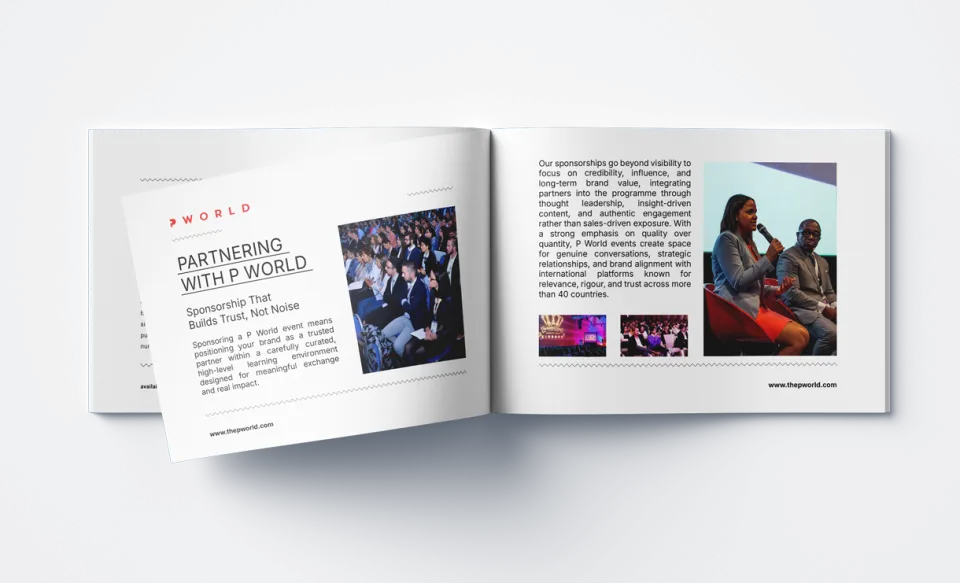
Download our Sponsorship Brochure
Explore all sponsorship packages, benefits, and pricing.
This program can also be delivered as a tailored in-house training for your organization. We adapt the content to your industry, objectives, and level of maturity, focusing on real challenges your teams face and the decisions they need to make. In-house formats allow your people to align on a shared approach, work through relevant scenarios, and build skills they can apply immediately.
If you’re exploring an in-house option, tell us a bit about your team, priorities, and timing, and we’ll recommend the right format.
Contact us about in-house training