
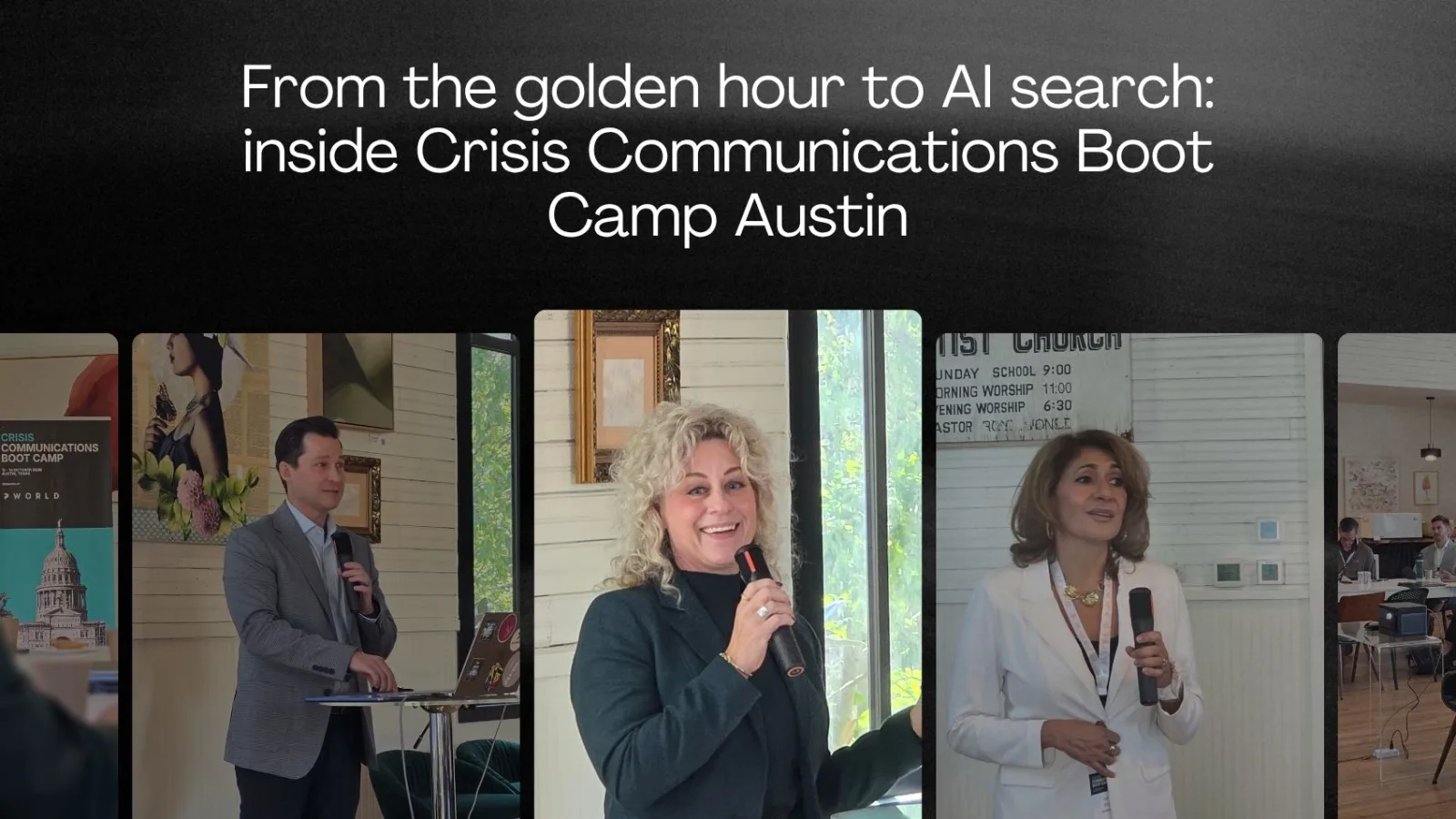
The first hour is decided before it begins
Farnaz Khadem, Vice President of University Communications at Stanford University, opened with a reminder from Norman Augustine, former CEO and Chairman of Martin Marietta / Lockheed Martin: there are only two kinds of companies, those that have been through a crisis and those that are about to. Her argument was that success in the first 60 minutes depends on how well you have planned in advance. That means knowing your likely crisis scenarios, your chain of command, what you are authorized to say and who to call, before you need any of it. It also means having an early warning system, because deciding whether you are actually facing a crisis is the basis for everything that follows.
Brent S. Gambill, Managing Director of Track Communications at NASCAR, spoke about handling crisis "at 200 miles per hour" in a sport where an issue can start on the track, at a venue, with a partner or as a reputational issue. His starting point is the same discipline: separate the initial story from the confirmed facts.
Kelly A. Nantel, Director of Global Operations & Workplace Reputation at Amazon, called this the "golden hour": acknowledge with empathy, put forward a credible spokesperson and make leadership visible. She pointed to American Airlines CEO Robert Isom, who had a personal video out within two hours of Flight 5342. "He didn't have all the answers. He said so. But he was there, he was visible, and he was human."
Say less, and make it hold
Once you do speak, the speakers agreed that less is more. Stanford's Khadem reminded communicators that "saying nothing IS saying something", that not every response needs to be an official statement, and that "we don't know" is sometimes the best message of all. Above all, you can't take back the first thing you said, which is why she urges communicators to make legal counsel their best friend.
NASCAR's approach favours a single statement, built to pass the test of time, with empathy rather than apology. Amazon's Kelly Nantel advised communicators to define the situation, not defend it. And Debora Lima, Managing Director of Sensei Advisory, encouraged teams to pressure-test every message with one question: would it remain credible if new facts emerge?
Communications belongs in the room
Amazon's Kelly Nantel challenged communicators to be a strategic powerhouse, not an order-taker. "Are you in the room when the decision is made? Or are you told after – and asked to 'message it'?" Earning that seat means leading with facts, being clear about the risk and always bringing a recommendation, not just the problem. As she put it: "Your job isn't to make leadership comfortable. It's to make them ready."
She also addressed the moment when Legal, HR and Comms pull in different directions. "All three are right. None can win alone. Your job: be the integrator." That means aligning on facts, keeping the debate moving and, once a decision is made, speaking with one voice.
Trisha McDonell added an important counterweight: no one should carry a crisis alone. "It's easy to think if you have crisis in your title, you are ultimately responsible for solving the whole thing. Don't do that to yourself." Communications works best as the connection between the experts who hold the facts and the leaders who make the decisions.
A plan is not a program
"Your plan is not your preparedness," reads one of Kelly Nantel's slides. Her prescription: simulate until the exercise breaks, train people to think rather than just follow the playbook, debrief honestly, and build relationships before you need them, because "trust is currency you spend during a crisis".
In her session, Trisha McDonell showed how a crisis program turns a plan into something people can use under pressure, across readiness, response and recovery. She also pointed out that crises can begin inside an organization, well before any headline, and that waiting for media attention risks leaving employee needs out of the response. Her closing line: "A crisis plan tells you what should happen. A crisis program makes sure it does."
The City of Austin brought that lesson to life. Jenny LaCoste-Caputo, Deputy Chief Communications Director, and Sara Henry, Chief Administrative Officer of Austin Emergency Management, shared how Winter Storm Mara in February 2023 tested the city, and how it reset its communications afterwards with a regular rhythm of updates timed for morning and evening news, a proactive approach to preparedness and new mandatory training.
Debora Lima's hands-on workshop and simulation put these ideas into practice. Her reminder for lean teams: readiness is a set of ordinary habits, starting with a named crisis lead, a backup and one shared incident log.
Knowing when to stay silent
Not every issue is a crisis, and not every crisis calls for a statement. Sensei Advisory's Debora Lima asked teams to first decide what they are dealing with: "Just because your blood pressure is high doesn't mean it's actually a crisis." She also reminded them that there is no perfect crisis response, only the one that best serves your most important stakeholders.
Adam R. Pratt, Director of Issues & Government Communications at IBM, applied that thinking to whether a company should take a stand on societal issues. Public expectations of corporate activism have shifted, he argued, and the effects of speaking out can last for years. His framework ties the decision to business impact: speak and act on issues at the core of your business, and treat strategic silence on unrelated issues as a legitimate choice. In his view, "no comment" is an active and often highly strategic decision. His three rules: know your audience, know your business, and know when to sit down.
AI is reading your reputation
Christina B. Frantom, Senior Communications Manager at Amazon, explored how AI search is changing crisis communications. "AI reads your reputation back to people," her presentation argues. "Positioning comes first. Optimization second." Her shorthand: "GEO = SEO + PR. Technical access gets you considered. Reputation gets you cited."
The takeaway for communicators is that earned media is what AI trusts most, and there is no shortcut: "There is no overnight version." In a crisis, AI answers with what is already published, so the facts, statements and archive you build beforehand shape what people are told when something goes wrong.
Debora Lima made the same point from the media relations side: "In an increasingly AI-driven media ecosystem, your voice, in your words, matters more than you'd think." Publishing your statements on your own channels helps make sure your version of the story is the one that lasts.
The work starts on Monday
Across every session, the message was the same: crisis readiness is not a document on a shelf. It is planning, practice, relationships and owned content, built long before you need them.
Debora Lima closed her workshop with a question worth asking of any team: "What is one readiness practice you will start, repair, or test when you return to work?" And as Kelly Nantel's final slide puts it: "You don't need permission to be the crisis leader your organization needs."
P World's next Crisis Communications Boot Camps take place in Hawaii on 22-23 February 2027 and in Nashville on 29-30 April 2027.