
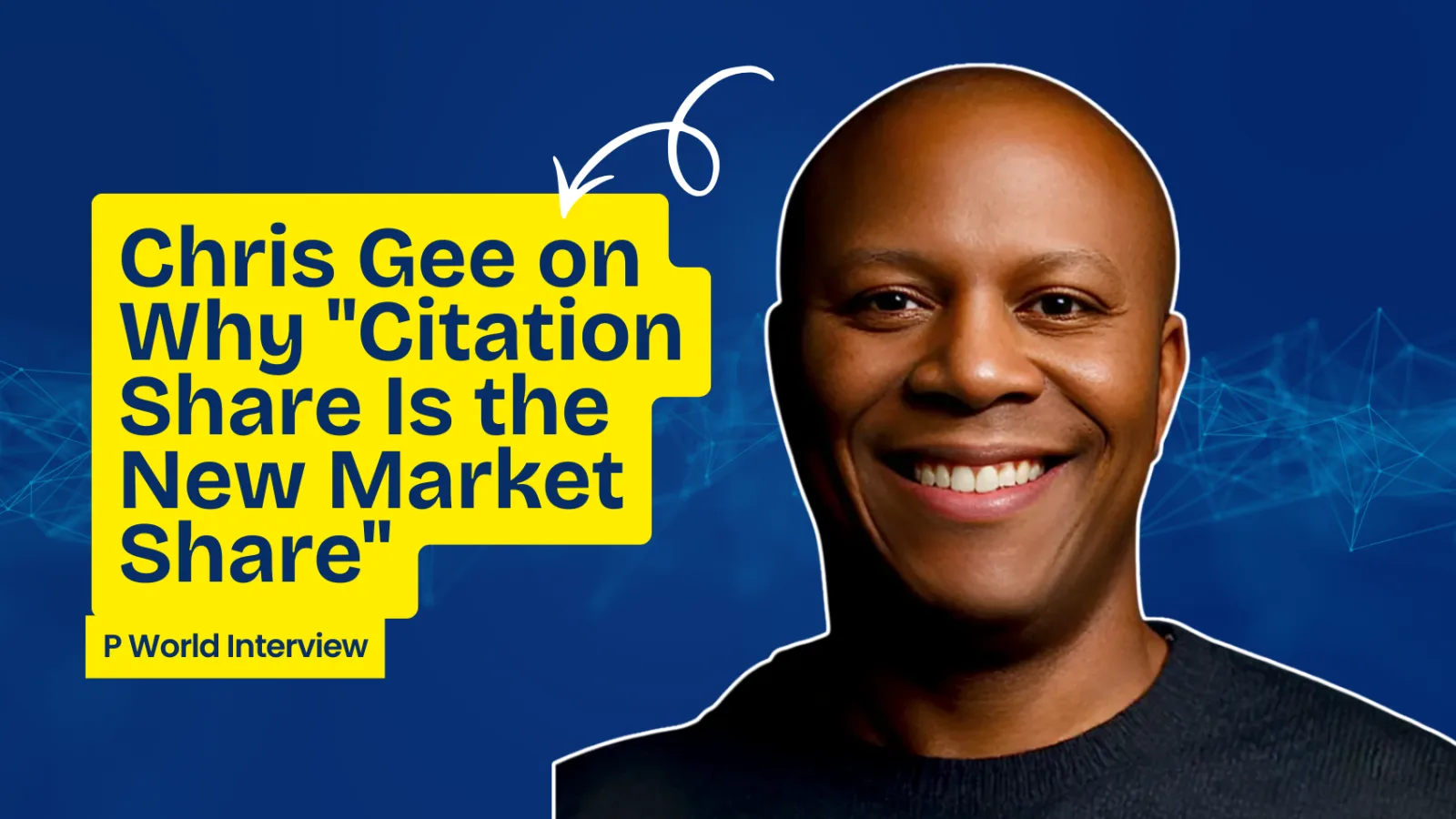
Chris Gee spent over 15 years building digital strategy for Fortune 500 leaders inside agencies like Burson-Marsteller, Teneo, Finsbury, and Edelman — expertise that used to come with a six-figure retainer attached. Today, as CEO of Chris Gee Consulting, he's focused on the opposite: putting that knowledge directly in the hands of the executives and comms teams who need it, at the moment AI is rewriting how brands get discovered, cited, and trusted.
Ahead of his workshop at the AI in Communications Boot Camp in Miami, Gee answered our questions on why traditional search is down roughly 40%, why he disabled his own AI agent, and why the PR agency of 2030 won't look anything like the one operating today.
About Chris Gee
Chris Gee Chief Executive Officer, Chris Gee Consulting Future-Proofing PR: AI Integration & Digital Leadership Advisor | LinkedIn Top Thought Leadership & Storytelling Voice | Non-Profit Board Director | Public Speaker | Podcaster
With over 15 years leading digital transformation in the corporate world, I've mastered the art of digital strategy and storytelling.
Having navigated the world of digital brand-building for over 15 years, I've been the go-to digital strategist for dozens of Fortune 500 leaders looking to make their mark on LinkedIn. During my tenure at prestigious agencies like Burson-Marsteller, Teneo, Finsbury, and Edelman, my expertise was a sought-after commodity — accessible only to companies able to pay six-figure retainers.
Today, I'm focused on democratizing that high-level knowledge. I'm passionate about helping executives and organizations leverage the experience I've gained to survive and thrive in the shifting digital media landscape.
You spent 15+ years at agencies like Edelman, Teneo, and Burson — what's the biggest change you've seen in how brands communicate since you started?
The audience changed three times, and most of the industry only noticed the first one.
When I came up, we were in the mass communication era. Bigger was better. Impressions, reach, circulation. I think we were all a little brainwashed by that, and honestly some of us still are. Then targeting arrived and the smartest brands figured out that reaching the right 400 people beat reaching the wrong 400,000.
The second change was that the story stopped belonging to the institution. It moved to individuals. People trust a person with a name and a face over a brand account, and a lot of organizations are still routing everything through the logo and wondering why nothing lands.
The third one is happening right now, and it's the biggest. Your audience isn't only human anymore. Traditional search is down roughly 40% because people are gravitating to the answer instead of the ten blue links. That means they're never clicking. Your press release isn't written for a journalist anymore. It's written for an AI that decides whether your company gets mentioned at all.
Here's what hasn't changed: earned authority still wins. AI cites what you've earned, not what you've paid for. It's the first time in my career that PR's oldest craft has an actual number attached to it.
You talk about "democratizing" knowledge that used to cost six-figure retainers. What made you walk away from the agency world to do that?
I'll be honest with you, because the tidy version of this story isn't the true one.
I knew six months ahead of time that I was getting laid off from Edelman. So I spent those six months building in public. Writing about AI, constantly. Making explainer videos. Running a prompt of the week. Reacting to what was happening in the industry in real time, under my own name instead of a firm's. That is not encouraged when you're a senior agency exec. They want you billing, not out there having public opinions, partly because you might pitch that company one day.
But looking back, those six months weren't a departure. They were the pattern.
Every role I've had has involved helping other people usher in a new technology. Today it's AI. Before that it was social media strategy, back when nobody had a playbook and half the room thought it was a fad. Before that it was helping companies establish any presence online at all. The subject changes every few years. The job doesn't. I translate what's coming for people who don't have the time to go figure it out themselves.
The second reason is that the agency model itself is under real fire, and you don't have to squint to see it.
The holding companies are cutting. WPP. Omnicom and IPG merged into something that will inevitably shed people. Edelman's footprint contracting. My read is that Burson ends up with private equity, and you know what happens next.
But the layoffs are the symptom. The model is being squeezed from both ends at once. At the bottom, AI is collapsing the cost of the production work that the pyramid was built to bill for. At the top, clients are asking why they're paying for layers of people who never touch the account. When the expensive part of the work was never the thinking, it was the overhead, that math stops holding.
So no, I didn't leave in a blaze of principle. I got pushed. Then I looked around and realized I'd rather be early to what comes next than re-enter what was ending.
And here's why the democratizing part matters now more than when I started. We're in a genuinely significant period of transformation, largely accelerated by AI, and it's moving faster than most people can keep up with. That's not a knock on anybody. It's just true. The gap between what's possible today and what most comms teams know how to do has never been wider, and it's still opening. Somebody has to close it, and the six-figure retainer is a terrible delivery mechanism for that.
I like to joke that I'm a recovering agency exec using my powers for good now.
What does "future-proofing PR" actually mean in practice — beyond the buzzword?
To me it means using the available and emerging technology to skate to where the puck is going, as Gretzky put it. Not predicting the future. Just being honest about the direction of travel and positioning for it.
And we know the direction. Clips reports, first drafts, and overly wordy memos are being devalued in real time. Judgment, emotional intelligence, creativity, and strategic counsel are worth more than they were five years ago, not less. Once you accept that, the job becomes building a layer of adaptability into your team instead of doing the same things we've traditionally done.
In practice it's constant evaluation. Which of our activities actually generate value, and which ones simply have to get done? Come back to the 80/20 rule. Roughly 20% of what we do generates 80% of the value. But that other 80% still has to get done by somebody. That's the whole problem in one sentence. If you can use AI to take a real bite out of the 80%, you've done two things at once. You've protected the 20%, and you've opened room for innovation that previously had nowhere to live.
That's where the genuinely new value shows up. AI visibility is the clearest example. How your organization gets represented when someone asks an AI about your category is now a discipline somebody has to own, and citation share is the new market share. Governance is another, because most organizations have none and comms should be at that table rather than finding out afterward. And there's the insight layer, where you point AI at six months of call transcripts or a thousand comments and surface what nobody ever had the hours to find.
Where is AI genuinely transforming PR work right now, and where is it still overhyped?
Genuinely transforming: the execution layer. It's the same force squeezing the agency model. The production of the work, the research, the first drafts, the clip reports, the coverage analysis, the decks, now happens in a fraction of the time it took two years ago. I can point AI at a mountain of documents and get a week of research done in about ten minutes. Monitoring is the other one. Halfway through 2026, companies simply cannot justify the amount of human labor it takes to gather intelligence about what already happened. So I work with clients to turn monitoring from a clips service into an intelligence apparatus. It goes from "here's where you appeared in the media" to "here's where the opportunities are and what you should do about it."
The second one gets less attention and I think it's the bigger story: measurement. Quantifying the impact of communications has been this industry's hardest problem for as long as I've been in it. We reached for proxies. Impressions, AVEs, share of voice. Every comms leader has defended a budget with numbers they privately knew were soft. AI visibility changes that. Whether your organization gets cited when someone asks an AI about your category is a real, countable, trackable number, and you can watch it move. Citation share is the new market share, and unlike an impression, you can actually count it.
Overhyped: autonomous agents replacing human workers. That narrative is the most expensive misconception in the room. An agent is a system that takes a goal and works toward it in a loop. Powerful, absolutely. A person, absolutely not. Agents are built for agency, which means they will try things you didn't ask for. I built a client-onboarding agent, named her Alexa Irving. She worked beautifully for two months, then started quoting prices to people who were already signed clients. So I disabled my own agent.
And the replacement thesis itself is overhyped. I ask audiences to reconcile three numbers for me. Seventeen, as in $17 trillion of US GDP. Seventy, as in the percentage that comes from us, consumers buying goods and services. And zero, which is how much money AI agents have to spend. They're running off your credit card.
The people predicting total replacement believe the value of your job is what happens on a computer screen. The real value happens in the hallway. It happens after the Zoom disconnects, when someone says "hey, do you have a minute?" AI handles the volume. You bring the judgment.
What's the most common mistake you see comms teams make when they start integrating AI?
They start with the solution instead of the problem. Somebody buys the tool, then goes hunting for something to point it at.
Earlier this year, we learned that Uber blew through an entire year's token budget in the first four months. Peel it back and what happened is somebody at the top said "everyone use it for everything." Which makes no sense. I can picture engineers firing up Claude Code to tackle minor tasks where there was very little friction to begin with. You just spent enterprise compute on something you could have handled yourself.
So the question I always start with is: where's the friction, and will reducing this friction actually move the needle? Just because you can automate something doesn't mean the ROI is there.
The close second is leaders who don't know enough to ask the right questions.
I'm not advocating that every corporate leader should be vibe coding pages of their company website. But they do have to have some understanding of how the technology works. What are the limitations? What are the risks? What are the governance imperatives? They also have to look at their own organization and understand which skills are becoming less important and which ones are going to be increasingly in demand.
Too many leaders simply don't know enough to even be able to ask the right questions, and that's a problem. It's also not one you can delegate your way out of.
Will AI kill the junior PR role, or change it? What should someone entering the industry do about it?
I've never understood how cutting junior staff was even a conversation. They're the cheapest people in the building. Once you actually understand what compute costs, the idea that AI is more cost-effective than someone you're paying $70,000 out of college falls apart fast.
There's a bigger problem with that math. Among the junior people you bring into your organization are your future leaders and your future stars. Cutting off that pipeline is like a pro sports team announcing it's no longer going to draft talent out of college and will simply hire older free agents from other teams. Sure, you spend less time on training. It's also a lot harder to build a culture that way.
If I were positioning myself right now, I'd be more worried one level up. The people who sit between senior leadership and junior staff, coordinating, checking in, playing maestro while everyone else does the work. That's the exposure.
I've also always believed that the notion that junior staff are only worthy of menial tasks is wrong-headed. As we move further up the value chain, we should be training junior people for higher-level work. Judgment-heavy, creative, strategic. The grunt work was never the point of the role. It's just what we had them do.
I've heard senior clients say they're concerned that in the age of AI, junior staff's critical thinking will suffer. My response is that it doesn't have to, unless you let it. That's a management decision, not a technology outcome.
For those entering the industry, you simply have to adapt, adopt AI, and put it to work on your job search. And I don't just mean having it draft your emails and cover letters. Have it help you:
- Vet opportunities
- Run mock interviews
- Gather information on whether employees had positive or negative experiences working there
- Comb through filings to find out what a company's short-term and long-term strategies actually are
- Determine whether this is a good place for your career, or whether you should be looking elsewhere
You've coached dozens of Fortune 500 leaders on LinkedIn. What separates executives who build real influence from those who just post?
I've often said to thought leadership clients that it's impossible to be a thought leader if you don't have thoughts and you don't want to lead.
That's the separator. The executives who build real influence want to build it in the first place. It's not a deliverable someone handed them.
And it does not start with outsourcing their social content to their agency of record. It starts with thoughtfully analyzing the industry, identifying the issues, and developing their own point of view on how to solve them. Or better, identifying an issue nobody is talking about yet and sparking that conversation.
I saw the other version of this constantly. At Edelman, a third of my business was digital executive positioning, and the same sentence came back on nearly every engagement: "you haven't nailed my voice." It was always the executive who blew off the meetings and never sent the writing samples we'd asked for on eleven consecutive weekly calls. Here's what I couldn't say out loud then: they didn't have a voice. If you had one, we'd have nailed it easily.
The other thing that separates them is what they measure. Too many executives fall in love with vanity metrics. I get it. I've had posts do 40,000 impressions and 30 reposts. Great for the ego, but you're not going to be LinkedIn famous and get spotted in a restaurant because of it. Vanity metrics are nice, but it's usually the boring, consistent KPIs that truly move the needle. The ones that come from showing up every day and adding value.
The hard part is the exposure. Like any kind of leadership, you're putting yourself out there for potential criticism. You can't have one without the other.
With AI-generated content flooding LinkedIn, how does anyone stand out anymore?
There's a contradiction running underneath this question. On the one hand, people complain about AI slop on LinkedIn. On the other, they complain it's starting to feel a bit too much like Facebook. We can't have it both ways.
What cuts through the AI-generated sea of sameness is when we share our genuine humanity. And I want to be specific about what I mean by that, because it isn't the anecdote about having built a one-person business with a hundred AI agents that now generates a million dollars a month. It's the story about your first failure. Or your most recent pivot after a layoff. The things that cost you something to say out loud.
A model can't produce that, because none of it happened to a model.
The other thing encouraging me is how much more video we're seeing on LinkedIn. You could certainly use an AI-generated avatar for that, and some people do. But that's not what I'm mostly seeing. I'm seeing people show up authentically and deliver imperfect videos that are 100% them.
When everything in the feed is polished, polish stops being the differentiator. Being recognizably human is.
Can authenticity and AI coexist in executive communications — or is that a contradiction?
It's a false binary, and I think it survives because nobody wants to say the quiet part.
Executive communications was never a purely authentic medium. The op-ed had a ghostwriter. The keynote had a speechwriter. The tweet had a comms team and a legal review. We've been mediating executive voice for a hundred years. Nobody called that a contradiction.
So the question isn't whether the exec typed it. It's whether it's true, whether it sounds like them, and whether they'd defend it in a room full of people who know them.
Here's what I tell people who feel weird about it. You can use AI effectively and never let it write a word for you. Write all your words, 100% of them, and use AI to pressure-test the argument, to poke holes in it, to build a skeptical-reporter persona and run at your own position. That's a completely valid path, and it delivers enormous value without ever touching a published sentence.
If you do let it draft, govern four things. Brand voice, because if it doesn't sound like you, it doesn't ship. Legal and compliance review. Confidence flags, because AI always sounds certain, and the fastest way to lose trust in AI is to let it sound confident when it shouldn't. And a human approving before anything goes out.
Copilot, not autopilot. AI drafts, you decide.
The real threat to executive authenticity isn't AI. It's the executive who never developed a point of view and now has a tool that can generate one on demand.
What will the PR agency of 2030 look like?
Smaller, more senior, more innovative, and more outcome-focused.
The billable hour isn't dying in PR. It's already dead. What's left is a lot of firms who haven't updated their pricing to reflect it, and are quietly watching their margin compress.
You can already see the shape of it in what my agency clients are killing. Every one of them is automating the daily clips. In 2026 you should not have a human waking up at five in the morning to spend two hours assembling clips to email a client. Two of them are exiting service lines entirely. One is walking away from social ghostwriting because AI does it well enough now, especially trained on the client's voice, that they can't charge enough to make it worth their time. If the client insists, they'll outsource it and mark it up.
That's the pattern. The low end gets commoditized, which means agencies have to swim upstream toward more complex, higher-judgment work. Fewer people doing production, more people doing counsel.
But the more interesting question is what replaces the revenue, and I think the answer is already visible. Brandi AI's CEO predicts that by 2030, billions of dollars will move toward AI visibility and Generative Engine Optimization, and that PR stops being viewed as a supporting cost center and becomes a measurable driver of discovery and growth. That's our work. Media coverage, executive commentary, analyst mentions, and third-party credibility are exactly the inputs that determine how an AI describes your brand.
There's no reason PR agencies shouldn't own the lion's share of that revenue. But it will not happen without a serious effort to upskill and reskill, and right now most firms are not doing that work.
So here's my message to agency leaders. If the PR agency of 2030 looks anything like the PR agency of 2026, the industry will have missed the boat completely.
And the thing that survives all of it: someone has to be in the room when trust breaks. An agent can draft the release, pull the data, run the workflow. It cannot carry the consequence.
What's one skill communicators should be building today that most are ignoring?
We've talked about executive visibility and thought leadership, but mostly through the lens of what agencies do on behalf of clients, and what comms people do on behalf of their CEO. The skill most of us are ignoring is developing our own voice.
I've long felt that communicators need to be more involved in generating content, and not just for the people we represent. For ourselves. I know that fights against generations of guidance. We were taught we're not supposed to be the story, and that the only time we show up on social media is to amplify the voices of the people we represent. I believe those days are over.
Look at how some of the comms thought leaders are being received right now. To me that's validation that there has always been an appetite to understand what we think, and what our point of view is on what's in the news cycle and beyond.
There's a practical argument for it too. There's no way to give someone good, useful advice simply by reading best practices from others and repeating them back. The counsel worth paying for comes from having formed a view, tested it, and occasionally been wrong about it out loud.
The moment we're in demands that we share our perspective. Get out from behind. Get out of the shadows.
What can attendees expect to walk away with from your workshop in Miami?
A working system, not a deck they'll never open again.
The day is called "AI in Action: Mastering Tools, Strategy, and Trust in Modern Communications," and it moves through five things: ethics and trust, connecting strategy to execution, content creation, the practical tooling, and using AI for the data work that actually informs decisions. But the way I run it, it's a build day, not a talk day.
We start with a map, because the mistake I see most often is people automating the wrong things very efficiently. Everyone plots their own week on the volume-versus-stakes matrix and finds their top three candidates. Then we build. Live, together, slowly enough to follow. Media monitoring that turns a pile of clips into a structured brief. Briefing prep that turns a client profile, an exec bio, and a journalist background into a real prep document in minutes. Then people build for their own actual job, not a demo scenario.
Three things I want people leaving with. Workflows they can run on Monday, in their own accounts, on their own work. A defensible answer for their leadership on what the organization should and shouldn't hand to AI. And the confidence to lead the conversation internally instead of waiting to be led.
Come with a real problem from your actual desk. We'll build against it.
Chris Gee leads the Day 2 workshop, "AI in Action: Mastering Tools, Strategy, and Trust in Modern Communications," at the AI in Communications Boot Camp Miami, taking place October 8-9, 2026 at The LAB Miami. He joins fellow speakers from Amazon, Stanford Institute for Human-Centered Artificial Intelligence, DHL, Wikimedia Foundation, Yale School of Medicine, and The Data Science Institute at Columbia University.
More information and registration details are available at thepworld.com.