
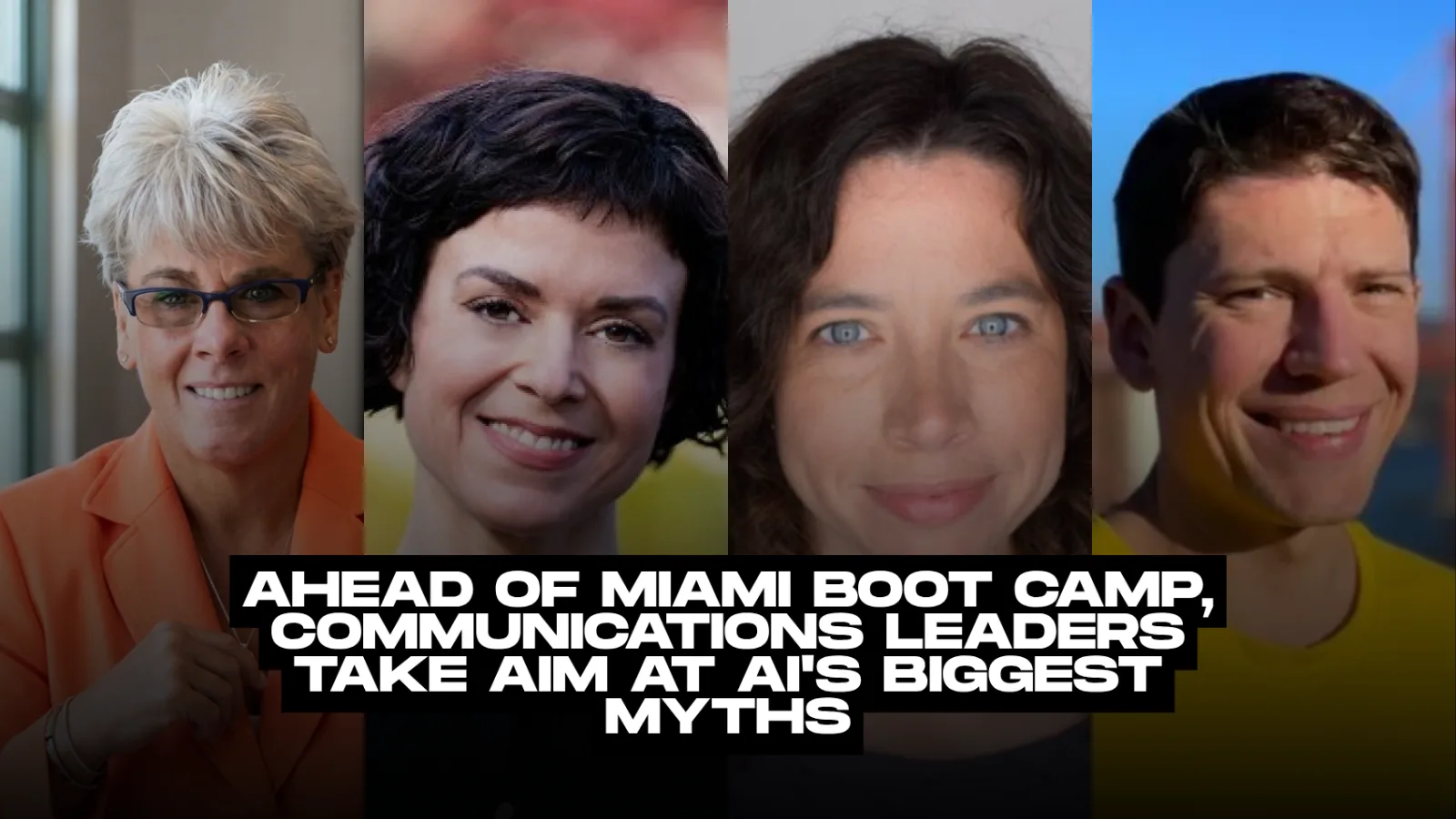
MIAMI — Ask a room full of communicators what they think AI can do, and you'll get two answers that can't both be true: that it will write your press releases for you, and that it can't write anything worth publishing at all. Ahead of the AI in Communications Boot Camp, taking place October 8-9 at The LAB Miami, four of the event's speakers were asked to settle the score. Their question: What's the biggest myth about AI in communications you'd like to kill?
Their answers, drawn from work inside some of the most scrutinized communications functions in the world, converge on a single idea — AI is not a replacement for judgment, it's a force multiplier for it. But getting there takes more effort than the hype suggests.
AI Doesn't Save Time. It Redirects It.
For Shana Lynch, Head of Content and Associate Director of Communications for the Stanford Institute for Human-Centered Artificial Intelligence (HAI) at Stanford University, the myth worth killing is the idea that AI can simply be sprinkled onto a project as a shortcut.
"The myth I would dispel is that you can just 'sprinkle a little AI' on any project to move faster and do more," Lynch said. "It can certainly help, but AI is like a green intern - enthusiastic, imperfect, and needing supervision. We don't save time so much as redirect it. Learning and vetting new tools, creating good prompts, refining results, and reviewing for accuracy all take focus. And with new platforms and capabilities dropping regularly, staying current is its own serious time commitment."
An Accelerant, Not an Autopilot
Kelly A. Nantel, Director of Global Media Relations at Amazon, pushes back on the idea that AI can run communications unsupervised.
"The biggest myth? That AI is some kind of autopilot for communications — that you can hand it the wheel and walk away," Nantel said. "It's not. AI is an accelerant. What I see every day is that it makes the work faster and easier, not automatic. It does do some of the thinking for us — drafting, synthesizing, spotting patterns in data — but the high-judgment decisions, the strategy, the actual calls about what we say and how we say it? That's still on us. It's the same principle behind our robots on the ground: they're designed to work alongside employees, in support of them, taking on the repetitive and physically taxing tasks so people can focus on the work that needs human judgment. AI augments people; it doesn't replace them."
Neither Camp Has It Right
Anna Spinner, who until recently served as Director of Communications at The Data Science Institute at Columbia University, takes aim at both extremes of the debate at once.
"The biggest myth about AI in communications is that AI can write for you. A close second: that AI can't write at all," Spinner said. "All-or-nothing thinking will hurt you either way. One camp outsources the thinking and gets slop. The other reads the slop and writes off the category. Neither has noticed that AI has no perspective of its own; it runs on yours. A system you've trained on your own material will draft faster than you can, catch some of what you missed, and push you toward a clearer version of the argument you were already making. But setting that up and using it as a thought partner is hard work. Skip it and you'll either sound like everyone else or dismiss something you never actually learned to use."
Keeping the Human in the Loop
At DHL, Matt Zuvela, Lead of AI Adoption & Regional Internal Communications (Americas), says capability was never the question — intent was.
"Just because AI tools can write our content for us doesn't mean it should or that we want it to," Zuvela said. "At DHL, we are finding the human touch to be more valuable than ever. We use AI for supporting tasks like transcription, but we always keep the human in the loop on content to keep quality, relevance, and authenticity high."
The Throughline
Across four very different organizations — a tech giant, a university institute, an academic research center, and a global logistics company — the message lands the same way: AI speeds up the mechanics of communications work, but it doesn't do the thinking, and it doesn't absolve anyone of the judgment calls that protect a brand's credibility.
That tension — between speed and judgment, automation and authenticity — is exactly what the AI in Communications Boot Camp is built to work through. Lynch, Nantel, Spinner and Zuvela will each lead sessions at the two-day event, taking place October 8-9 at The LAB Miami, alongside additional speakers from Wikimedia Foundation, Yale School of Medicine, and Chris Gee Consulting. The Boot Camp follows sold-out editions in Chicago, New York, and Los Angeles.
AI in Communications Boot Camp Dates: October 8-9, 2026 Location: The LAB Miami, 2750 NW 3rd Ave #24, Miami, FL 33127
More information and registration details are available at thepworld.com.