
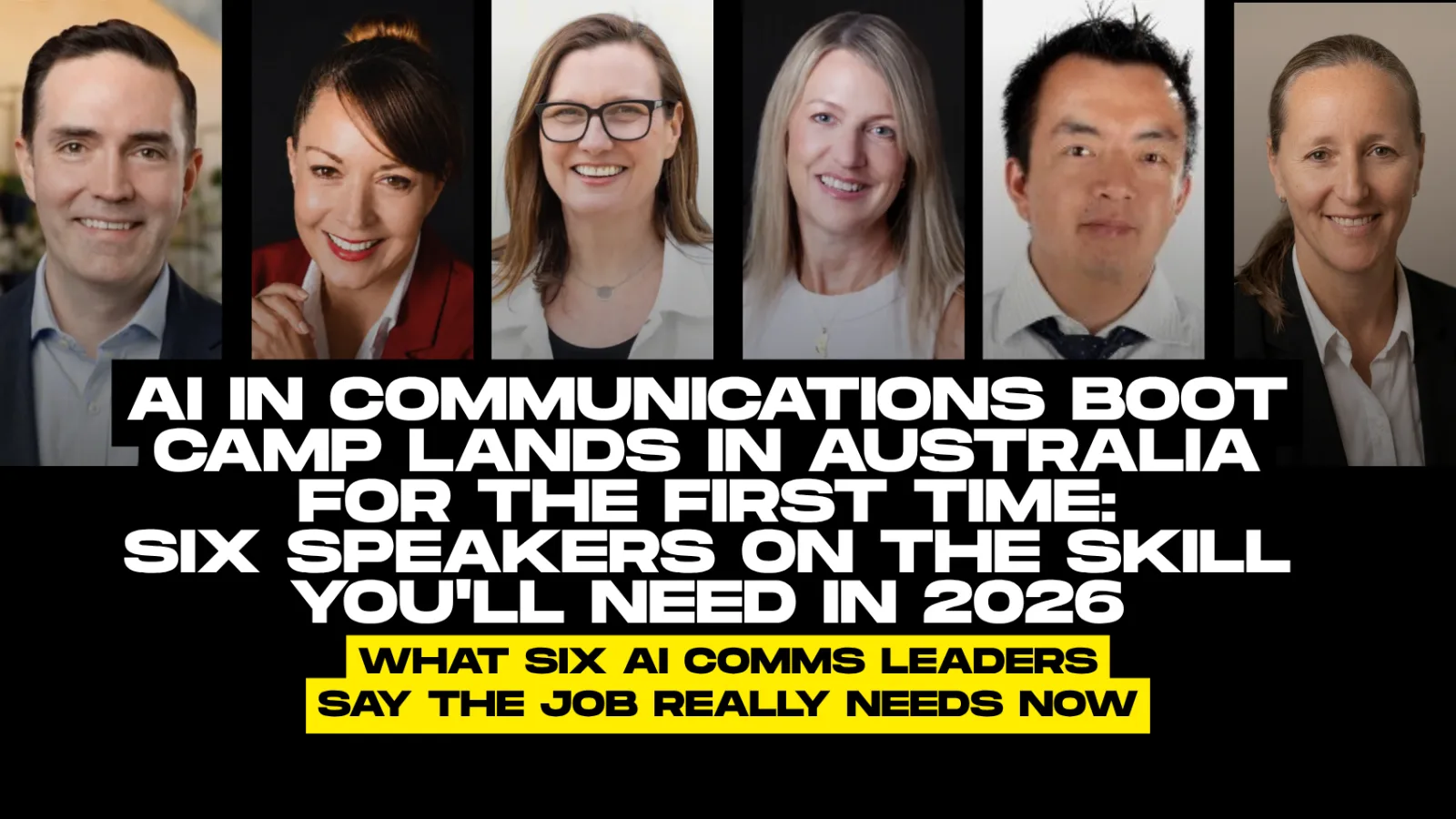
Ahead of the event, we put the same question to six of the speakers taking the stage: "What's the first AI skill every communicator should master in 2026?" Not one of them said prompting. Instead, their answers converged on a theme that says a lot about where the profession is heading — as AI absorbs more of the drafting, the communicator's real value moves upstream, into judgement, trust and leadership.
Judgement over prompting
For Dr Karen Sutherland, Certified AI Consultant and Senior Lecturer at the University of the Sunshine Coast, the obvious answer is also the wrong one. "Everyone expects me to say prompting," she says. "I'd say the first skill is knowing what good looks like well enough to reject what the tool gives you. AI output is fluent by default now, and fluent is not the same as accurate, on strategy, on brand, or in your client's voice. The practitioners doing this well are not the ones with the cleverest prompts. They're the ones who stayed the subject matter expert. They're the ones fact-checking, editing and adding their human sparkle before sending AI generated content out into the world."
Summer Goodwin, Associate Director, Strategic Communications (Research) at the University of Melbourne, frames it as discernment — including the discernment to answer the question herself rather than outsource it. "Discernment. When to use AI and when to create from scratch," she says. "I could easily write a prompt and ask AI this question. But you're seeking genuine input from your speakers. As AI integration matures in communications teams, leaders will need to ensure appropriate principles and frameworks for decision making are in place."
Caroline Page, Head of Communications at Virtually Human, arrives at a similar conclusion from a different angle: as more organisations run the same models, the models stop being the differentiator. "The most important AI skill for communicators in 2026 is editorial judgement," she says. "AI can produce polished content in seconds, but it defaults to predictable structures, familiar language and increasingly homogeneous outputs. As organisations adopt the same models, differentiation will come from the communicator, not the technology. The real advantage lies in knowing what to keep, what to challenge and what to rewrite, so every piece of communication reflects clear thinking, strategic intent and a distinctive brand voice."
Leading people, not just prompts
If judgement is about what stays out of the final draft, Alexandra Futeral, AI Strategic Leader and Researcher, says the bigger skill is helping an entire organisation move through the change AI is forcing on it. "The first skill every communicator should master in 2026 isn't a tool. It's becoming a change leader," she says. "AI has changed our role for good. It's no longer enough to do the job the traditional way — writing, messaging, managing reputation. We're now also expected to help our organisations move through the biggest shift the workplace has seen in a generation. A change leader does exactly that: bringing people with them, easing the worry AI creates, and building the confidence to use it well. This is the human factor at work. AI can write the message, but it can't build the trust behind it — and that's the part only we can do."
Working the tool properly
Matthew Wu, Communications Manager, Australia & New Zealand at Amazon Web Services, takes the conversation back to the coalface: most communicators, he argues, still haven't learned to use the tool itself well. "Learn how to properly engage with the chatbot," he says. "Most treat it like a search box: type once or twice, take whatever comes back (zero-shot). The reply will always be generic unless you give it something to work from. A tight, detailed brief with the outcome you want gets a better result, just like briefing a photographer for a shoot or a creative agency for a big idea. Push back when an output is soft or doesn't hit the mark. Tell it why. Have a conversation with it (use the voice mode!). Feed it the right data — stay within your company guidelines on AI usage — and it'll come back with something much better and personalised. Then keep refining until it sounds like you (or your brand). Finally, share your learnings to your team and mates to upskill their knowledge and understanding. Bonus tip: learn how to create and install a voice/tone md file."
Managing what the machine already knows about you
Tim Madin, EY Regional Strategic Communications Leader, Oceania, takes the widest view, arguing that the job itself is being redefined by a second, non-human audience. "The first skill is managing the record an AI learns from," he says. "For most of our careers, we've been writing for a human audience. Sometimes it's a journalist, a client, or an employee. That's still the instinct that I fall back on, but I think that's not going to be enough in 2026 and beyond.
"That's because now we're writing for the machine as well. A growing share of your audience will never read your work directly. They will read what an AI told them about it. When someone is looking for what your organisation stands for, they're not going to trawl through all your media releases on your website. They're going to go straight to their model of choice, and take the answer at face value. If the record is out of date or incorrect, the AI will fill the gap with whatever it can find. That could be a biased news article or an old version of the story from three years ago. As the model currently works, it'll do this with the same confidence it always does, whether it's right or wrong.
"So the job is changing. We're not just landing the story anymore. We're managing the trail of information the AI learns from, and making sure the version it repeats is the one that actually happened. That means building a record across several credible sources, not one page in your about section. It means telling a consistent story across multiple channels. I think rather than going for a single exclusive, go for coverage that gets picked up and syndicated, because it will appear more credible to the AI.
"But this still doesn't replace judgement or the relationships, which matter more than ever. Now that you're augmented with AI, so is your audience. They're part human and part machine. You can ring and ask a journalist to fix a story. You can't ring an AI model."
The takeaway
Six speakers, six different starting points — prompting technique, editorial judgement, change leadership, discernment, brand-record management — but the same conclusion sits underneath all of them: the tool is not the skill. Knowing when to trust it, when to overrule it, and how to keep human judgement and relationships at the centre of the work is.
Futeral, Page, Goodwin, Sutherland, Madin and Wu will unpack all of this in far more detail at the Certified AI in Communications Boot Camp Australia, 12–13 November 2026, at the Hilton Sydney — the program's first stop in Australia after sold-out runs in New York, Zurich, Brussels, Miami and Vancouver. Attendees leave with a Certificate of Attendance from the McMaster University Master of Communications Management.