
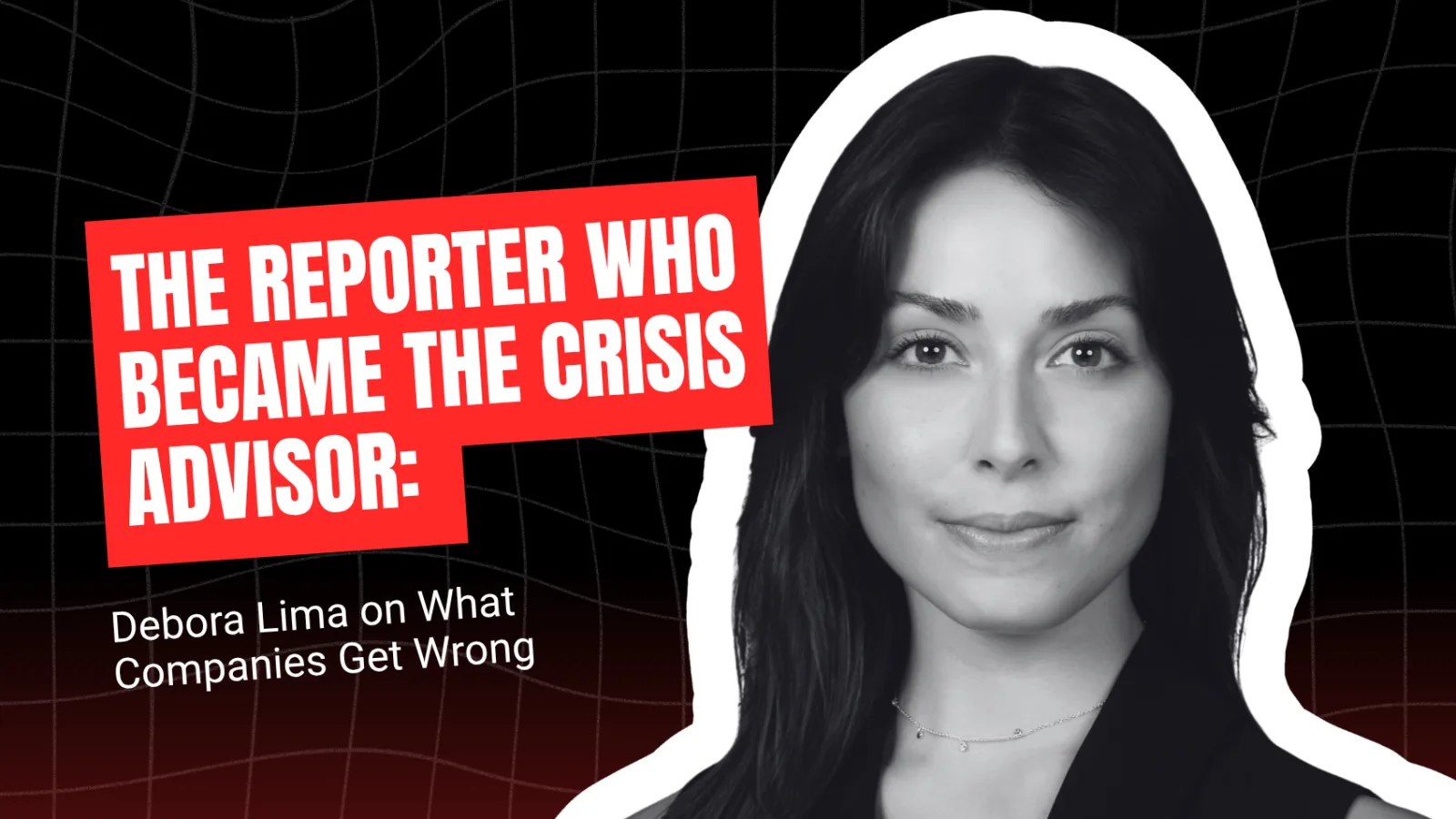
Before she was advising clients through funding rounds, M&A, SPACs, and litigation, Debora Lima was on the other side of the phone call — chasing sources, filing FOIA requests, and helping the Miami Herald's investigative team make sense of the Panama Papers. That dual vantage point, newsroom and war room, shapes almost everything she now tells clients under pressure: stay composed, disclose the basic facts, and never mistake silence for a strategy.
Lima will lead the full-day Day 2 workshop at the Crisis Communications Boot Camp in Austin, a hands-on tabletop exercise built around a real-world incident involving a global consumer brand. Ahead of the event, she answered our questions on what journalism taught her about crisis behavior, where AI is already changing both the newsroom and the war room, and what attendees should expect to walk away with.
About Debora Lima
Debora Lima Managing Director, Sensei Advisory
Debora leads strategic communications for Sensei Advisory's client portfolio, with a focus on issues management, stakeholder engagement, and litigation support. A former journalist, she contributed to the Miami Herald's Pulitzer Prize-winning investigative series on the Panama Papers and was named a top beat reporter by the Society of Professional Journalists in 2018. She transitioned to communications by applying her background reporting on real estate and tech to an agency role directing media and investor relations for VC and venture-backed startups across material events, such as funding rounds, mergers and acquisitions, SPACs, and IPOs.
You contributed to the Miami Herald's Pulitzer-winning Panama Papers investigation — what did working on one of the biggest leaks in history teach you about how organizations behave under pressure?
Organizations under pressure too often behave too nakedly like they are, in fact, under pressure. By that I mean, at the first sign of material risk through an engagement with the media, companies suit up for battle – they take the email thread with the reporter offline, loop in legal to make a call to so-and-so at the paper, the tenor of the engagement with the news team shifts from amiable to testy, so on and so forth. This applies broadly, but my experience supporting the investigative team at the Herald on the Panama Papers series was my first glimpse of how counterproductive it can be for a subject – person or entity – to take on an antagonistic position.
This is probably obvious but bears repeating: Journalists only become more persistent when the company or person they are reporting on takes on a defensive posture in response. Now that I'm on the other side of those engagements, working with newsrooms on behalf of clients, I insist on maintaining composure and keeping reactive or protective measures proportionate to the circumstances as we understand them to avoid signaling to journalists that they've hit the jackpot with their line of questioning.
At the time the Herald began working on its Pulitzer Prize-winning series on the Panama Papers, I was writing feel-good community news stories for the "Neighbors" section – about as far from a Woodward/Bernstein scenario as you can imagine – but as the one person in the newsroom who spoke Portuguese, I got re-assigned to call up sources in Brazil and parse through the mountains of documents that ICIJ mailed to the Doral newsroom to interpret the context of these shell company-backed real estate deals that the series would explore. Even in that pretty fringe capacity on the project, I ended up on the receiving end of intimidating emails and calls. The chilling effect that was probably intended to have only motivated me to work longer hours to see what I could help find, which became easier each time someone suggested I look the opposite way.
What made you cross over from journalism to communications — and what surprised you most on the other side?
It pains me to say it, but my decision to leave journalism for a comms role with a venture capital firm — after covering real estate at the Herald, I became the startups and VC beat reporter for the ACBJ paper in Miami — was motivated entirely by dollars and cents.
It was a real identity crisis for me to take on the role of "flack" after so much shop talk with colleagues about the hundred and one missteps of publicists, with whom we pretty much only deigned to work. Ultimately, having had the opportunity to learn first-hand what ticks off reporters and their editors is an invaluable skill for comms because, what continues to be most surprising to me now that I'm on the client side of media engagements, is that good comms strategy has to involve upside for the reporter, too. Without factoring in the need for mutually beneficial outcomes, you become susceptible to poor judgement and make bad decisions. When I'm hiring, I prioritize recruiting former journalists, especially those who are fresh out of the industry, because it helps us keep our grip on the ability to find common ground with the media as it's currently operating.
As a former investigative reporter, you know exactly how journalists dig. How does that change the advice you give clients in a crisis?
My team probably calls me "broken record" behind my back because I repeat a few rules of thumb or principles to clients as often as I possibly can without becoming totally annoying.
The first is that internal communications might as well be a headline or a press release because leaks and whistleblowers are increasingly common, so try to not say or do anything within your organization that you wouldn't be prepared to stand by in a public forum.
Number two, and this is somewhat an extension of No. 1: Your employees can be your biggest boosters and validators or your worst critics and enemies, so operate accordingly. Ideally, that means solid corporate governance and a culture of good management, compensation, and accountability, but at the very least, good lawyers who can draft and enforce CYA (cover your ass) policies.
Lastly, practice good documentation hygiene. You'd be surprised how little the average person understands about the fairly expansive bounds of the Freedom of Information Act - especially in Florida, where almost everything is public. Even innocuous-seeming details can be extrapolated and add inches to an already-damaging narrative you wish weren't out there, so be mindful of what goes in writing and how those documents are maintained and protected.
What's the most common thing companies get wrong when a reporter calls about a damaging story?
Inaction is a form of action. Wavering, delaying, going radio silent - each represents a decision, whether active or passive, that can change the result of a media relations exercise, and buying time without a plan of action to justify it can be detrimental. The best way to make it easy (or easier) to take decisive action when you get that dreaded call or email is to plan ahead. You should know exactly what you would do in the day or two after a media inquiry pertaining to something potentially controversial would look like, hour by hour, and if you don't, figure it out before you need that gameplan.
Litigation support is a unique corner of comms — how do you balance what lawyers want to say (nothing) with what the public needs to hear?
Success in litigation support hinges on the ability to make a strategic communications recommendation to the client that reconciles legal concerns and reputation management objectives in a pragmatic sense. That means understanding the material risks and determining the two or three most likely scenarios to come up with a tactical response. Ultimately, you have to be prepared to concede on what the ideal plan is because the divergence between legal and comms is often so massive, but trying to push through a plan that legal won't back is an easy way to waste time and energy. My general approach is to identify the non-negotiables — theirs and ours — and work from there.
Is "no comment" ever the right answer?
Why say "no comment" when silence serves a similar, and perhaps better, outcome?
That being said, I typically push for approval to comment, even if only on-background, because not engaging limits your future options with the news organization that requested comment.
The typical scenario is that the request for comment comes in, it goes unanswered – or "no comment" is issued – and the resulting coverage contains one or more substantive inaccuracies that should ideally be corrected. In that scenario, few journalists would be inclined to play ball with a setrec because their thinking is they give you a chance to ensure accuracy in the reporting, but that opportunity was dismissed.
What does good issues management look like before anything goes wrong?
Good issues management requires foresight and a strong dose of humility and self-awareness. As a business leader, it's uncomfortable to reckon with the weaknesses of your organization, and it's doubly uncomfortable to invest in fixing them before the critical need to do so emerges, whether in the form of a challenging media inquiry or scrutiny from another important stakeholder group, be they shareholders or regulators. What is truly most uncomfortable, however, is having to respond to intense scrutiny around a vulnerability that's been exploited, as well as the failure to identify and/or address that vulnerability. From the perspective of the comms team, you have to build trust with leadership so they'll accept the discomfort of issues management and believe that it'll be minimal compared to the emotions that crisis management tends to elicit.
You've directed comms for funding rounds, M&A, SPACs, and IPOs. Which of these is the most dangerous from a communications standpoint — and why?
The string of failed SPACs we saw in the last decade gave those financial transactions a bad rap, fairly or otherwise. For the average person, SPACS seem very complex, or arcane, at best and sketchy at worst, then when you factor in the reality that the average reporter in a position to cover a SPAC today is someone who, compared to whoever would have been in their seat a decade or two prior, is overworked and under-resourced, comms around a SPAC involves a lot of risk to mitigate errors in interpretation, reporting, and public reception. I'd take any other type of financial comms engagement any day over a SPAC.
What's a material-event announcement you've seen go sideways, and what was the lesson?
Any funding round that doesn't disclose basic facts - namely, the dollar figure and information on the cap table — turns out less favorably than it should. With the bar for what's newsworthy or not in a funding round only getting higher each day, the lesson should be that you disclose all the basic facts plainly and ensure that, in concert, those facts are woven into a compelling story that's less about a dollar figure and more about impact – who the investors are, why they chose to invest, how that investment will be allocated, and what real-world impact that allocation is intended to have and what metrics will be applied to measure it.
How is AI changing both sides of your world — the newsroom and the war room?
AI is accelerating the erosion of the journalism industry in more ways than I have time to write about. But from a client support perspective, AI is making data verification more important and more time consuming; we're finding ourselves going through data underlying metrics that we intend to share publicly with a fine-toothed comb more than once to avoid the embarrassment associated with errors caused by AI hallucinations.
What's one skill every crisis communicator should steal from investigative journalists?
Knowing how to access public records through online databases and FOIA requests can be really meaningful for effective due diligence; clients don't always know what they don't know, and if it's anyone's job to figure it out, it's probably the comms team's. If you can pinpoint what is already out in the public domain and verify it, that level of resourcefulness is highly valuable in a crisis planning or management context.
What will attendees walk away with from your workshop in Austin?
For the foreseeable future, successful crisis PR will involve prioritizing engaging journalists and LLMs on an almost equal level as audiences continue to shift their discovery habits away from traditional media, and even social channels, to AI. My workshop will focus on retooling crisis management for new information channels and providing an understanding of what can and can't be controlled in this new landscape.
Debora Lima leads the Day 2 workshop, "Crisis Communications Tabletop Exercise for the Modern Media Landscape," at the Crisis Communications Boot Camp Austin, taking place October 15-16, 2026 at The Cathedral ATX. She joins fellow speakers from Amazon, NASCAR, IBM, Stanford University, Mercedes-Benz U.S. International, Entergy, City of Austin, and Flex.
More information and registration details are available at thepworld.com.