
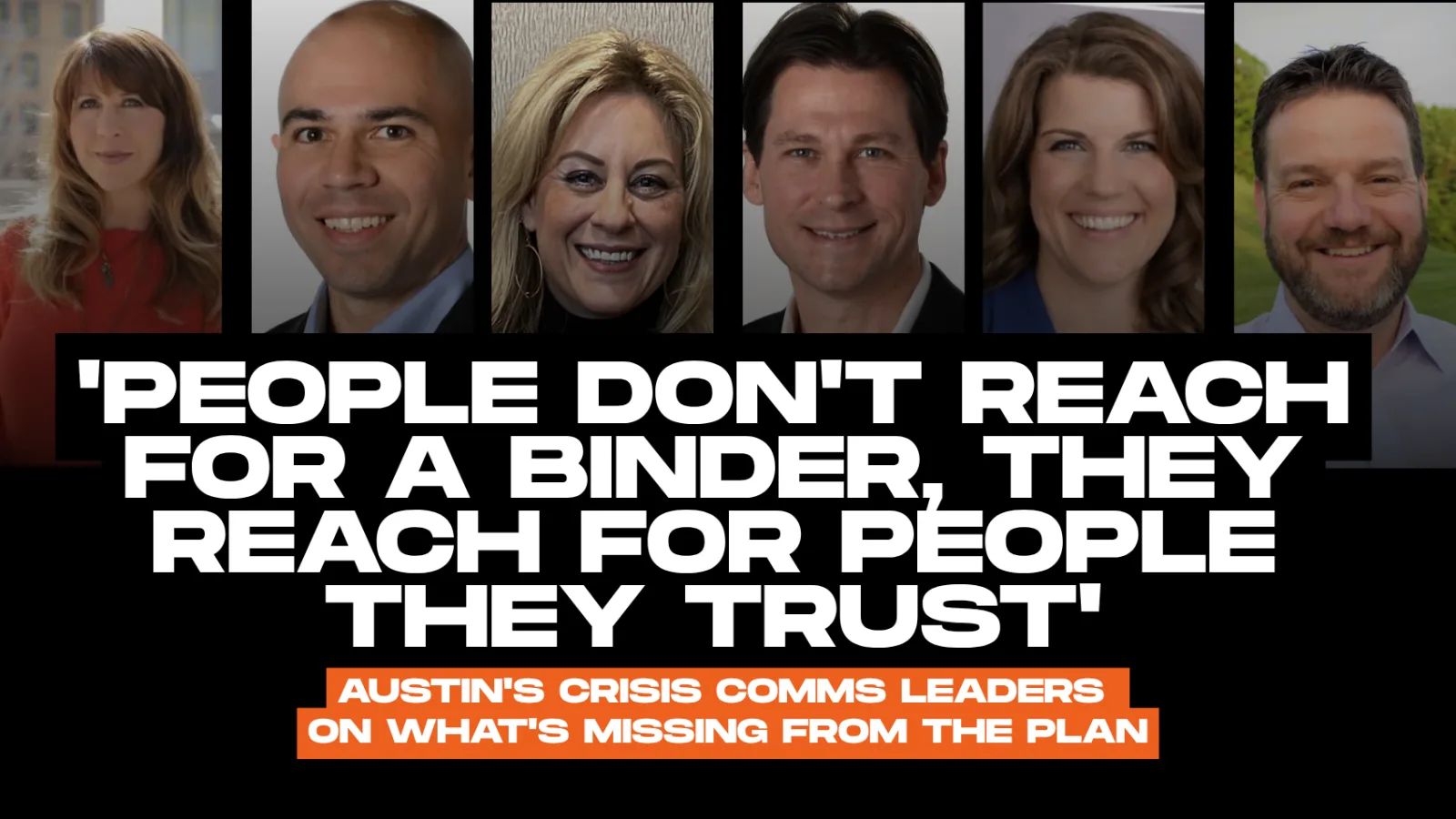
AUSTIN — Every organization has a crisis plan. Fewer have one that actually holds up once the crisis arrives. As the professionals gathering in Austin on 15-16 October for the Crisis Communications Boot Camp make clear, the gap is rarely the document itself — it's whether the people, structure and relationships behind it have ever actually been tested.
That is the thread running through the Boot Camp, taking place 15-16 October 2026 at The Cathedral ATX — part of a global training series delivered in over 40 cities, returning to Texas after five years away. Ahead of the event, we asked the speakers one question: what's the one thing every crisis plan needs — that most are missing?
For Christina Frantom, Internal Communications Lead at Mercedes-Benz U.S. International, Inc., the answer starts with practice.
"The thing most crisis plans are missing isn't a tool or another section, it's a rehearsal," says Christina Frantom, Internal Communications Lead at Mercedes-Benz. We work so hard to draft the plan, run it through approvals, and audit the plan every year. That hard work is wasted if you don't run drills. A plan is only as strong as the readiness of the people executing it. "A plan that sits on the shelf collecting dust won't save you if your leadership has never opened it." Your comms team can't manage a crisis alone. The real work is building partners across the organization who know the plan, have run the drills, and are ready to act when it matters. "You'll be grateful in a crisis that the plan works exactly like you wrote it, and that only happens if your organization has practiced it."
Brent Gambill, Managing Director, Track Communications at NASCAR, locates the gap one level up — in how decisions actually get made.
"Every crisis plan needs a clear decision-making framework—because that's what most organizations are missing. The best plans don't just outline what to say; they define how to gather facts, align leadership, make decisions, and communicate with one clear voice. In a crisis, trust is built by having the right process before you need the right words."
For Jenny LaCoste Caputo, Deputy Chief Communications Director for the City of Austin, that framework has to end somewhere — with a name, not a committee.
"A clear decision maker – at all times. Too often decisions are made by committee, which leads to devastating delay. That delay can literally be deadly in situations like natural disasters or a public safety crisis. It can also kill an organization's reputation. Of course it's important – and necessary – to consider perspectives and legal concerns when crafting a message. But ultimately, someone needs to be responsible for making a decisive, timely call. And that person should be arm-in-arm with their communications chief."
Trisha McDonell, Vice President, Public Relations at Flex, argues none of it works if the relationships aren't already there.
"The most overlooked part of a crisis plan isn't a playbook. It's trust.
You can prepare for every scenario imaginable, but when the pressure is on, people don't follow a process, they follow the people they trust.
Trust isn't just believing your crisis team is competent. It's believing they'll help solve the problem, not create another one.
When leaders see their communications team as a strategic partner, they pick up the phone early. You have time to assess the situation, align stakeholders, and shape the response before the narrative gets away from you.
Without that, people work in silos, second-guess decisions, and valuable time is lost.
When a crisis hits, people don't reach for a binder, they reach for people they trust. Build that trust early, and the plan becomes a tool instead of just a document."
For Brandon Scardigli, Communications Manager at Entergy, even the best-prepared teams tend to stop planning too soon.
"The one thing every crisis plan needs, and most are missing, is a forward-looking playbook for the second and third phases of a crisis. Too many plans stop at the first 24-hours, when the real test often begins days or weeks later. Effective crisis planning isn't just about managing what's right in front of you, it's about anticipating what obstacles will emerge three, five, or even fourteen days from now, and making decisions today that set you up to navigate those future challenges. Building that long‑game mindset into your plan ensures you're not just reactive, but ready for the evolving realities every crisis inevitably brings."
And for Adam Pratt, Director, Issues & Government Communications at IBM, even a well-drilled, well-structured plan can fail a simple test: it was never seriously challenged from the outside.
"What are most crisis comms plans missing? Most often, it's context. Outside-in thinking. There's a compulsion in many cases to close ranks, tackle the problem and build out the scenarios, statements and activation plans. That's all well and good, but the old saying that few plans survive first contact with the enemy is especially true for plans cooked up in an internal bubble. Seek outside expertise and perspectives, and use AI to pressure test concepts and even aggressively pick apart your plans and positioning. The added effort will be more than worth it."
The two-day Boot Camp brings together speakers from Amazon, Stanford University, IBM, Mercedes-Benz U.S. International, Entergy, City of Austin, Flex and NASCAR. Day one covers crisis leadership and decision-making, the first 60 minutes of a crisis, building a crisis program that performs under pressure, and communicating without all the facts; day two is a full-day, hands-on tabletop exercise led by Debora Lima, Managing Director of Sensei Advisory, who contributed to the Pulitzer Prize-winning Panama Papers investigation.
The Crisis Communications Boot Camp Austin takes place 15-16 October 2026 at The Cathedral ATX. Full program and registration: thepworld.com