
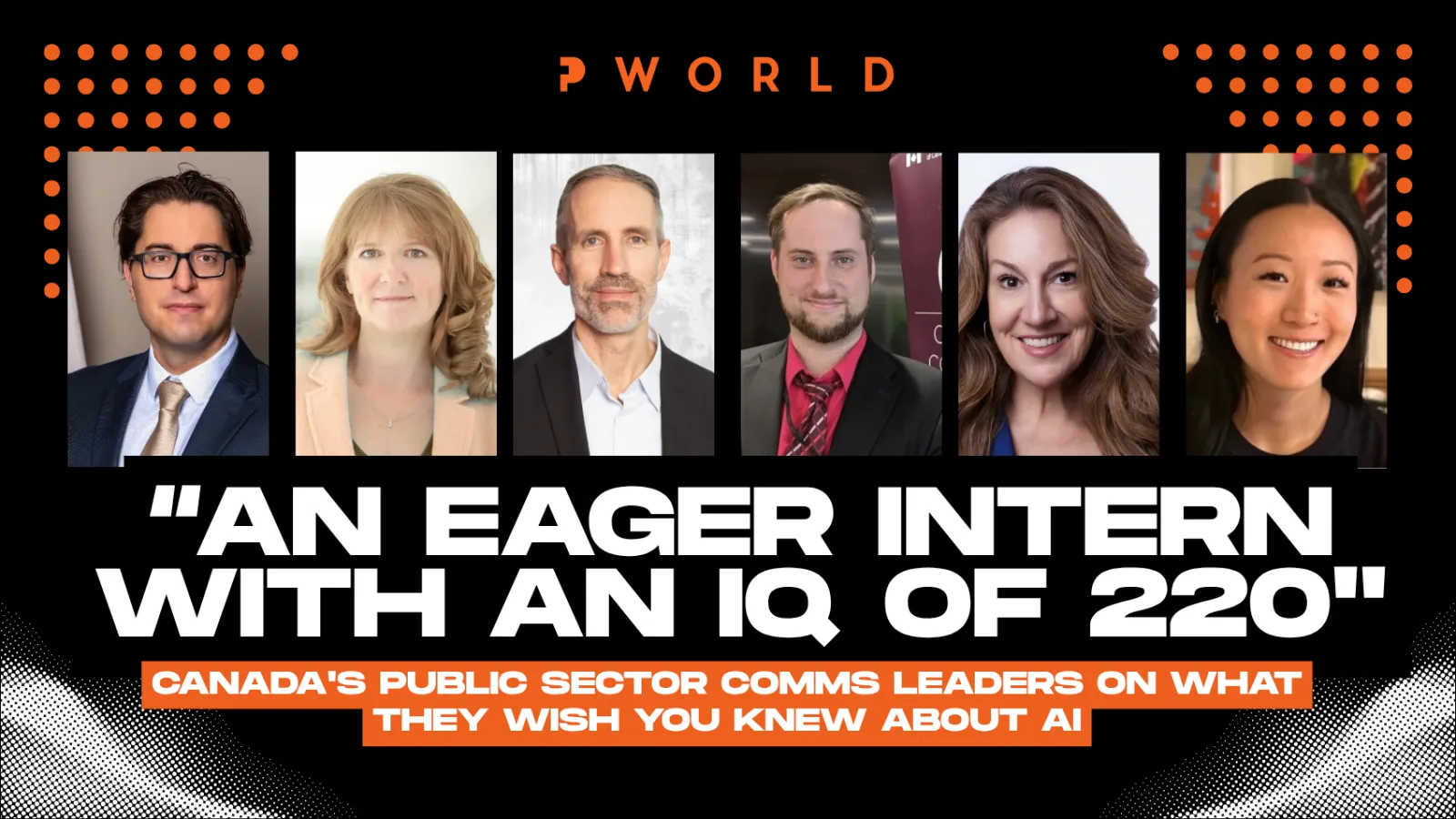
OTTAWA — As AI moves from experimentation to everyday practice inside government communications teams, the professionals gathering in Ottawa on 16-17 September for the Certified AI in Communications Boot Camp for the Public Sector have a consistent message: the technology is powerful, but the judgment, accountability and trust that define public sector communications remain firmly human.
That is the thread running through the Boot Camp, taking place 16-17 September 2026 at the Delta Hotels Ottawa City Centre — the first practical, implementation-focused AI training in Canada designed specifically for government and public sector communicators. Ahead of the event, we asked the speakers one question: what's one thing you wish every public sector communicator knew about AI before they start using it?
For Julia Oosterman, Chief Communications Officer at the City of Toronto, the answer starts with a clear division of labour.
"If I could share one thing with every public sector communicator before they start using AI, it would be this: AI is a powerful assistant, not an authority. Its greatest value is helping us work faster, think broader, and improve efficiency, but public trust, judgment, context, and accountability must always remain human responsibilities. The most effective communicators use AI to support drafting, analysis, research, and workflow improvement while maintaining rigorous human oversight of facts, tone, ethics, privacy, and public impact. In fact, AI makes communicators more—not less—important. Many AI tools draw heavily from high-quality journalistic sources, trusted public information, and credible published content, reinforcing the value of professional communication and accurate storytelling. As misinformation proliferates, the role of communicators as trusted stewards of facts, context, and credibility becomes even more critical. Success with AI is therefore not about replacing human expertise, it's about combining the speed and scale of technology with the judgment, integrity, and trust that citizens expect from public institutions. This reflects the City of Toronto's approach to AI in communications, where governance, privacy, transparency, and responsible use are foundational to maintaining public confidence.
"AI doesn't diminish the communicator's role—it elevates it because credibility becomes more valuable in an AI-driven information environment."
Kim Blanchette, APR, Chart.PR, FCPRS, EVP, Corporate Training at ChangeMakers, puts the same warning in more vivid terms.
"AI is like an eager intern with an IQ of 220. The output is fast, confident and desperate for affirmation. There's also zero accountability when it's wrong (it may even double-down when challenged). You'd never forward someone's first draft to a decision-maker without edits, don't start now. Before you use it for anything that goes public or informs a decision, decide in advance the level of verification that piece of work needs. Verify every output like your organization's reputation depends on it, because it does."
For Christian M. Connolly, Regional Communications Director at Indigenous Services Canada, the starting point is asking the right question.
"I think the most important thing is to know that AI is not a magic wand that will replace your work or think for you. It can greatly enhance your work, but you still need to review and apply your own judgment. At the end of the day, AI is a collaborator whose work you are accountable for. I think the key component is to not ask 'Can AI do this for me?', but rather ask 'What role can AI play in helping me do this responsibly?'"
Lisa Zhao, Enterprise Account Executive, Canadian Public Sector at Meltwater Canada — the event's strategic partner — argues communicators are looking at AI through the wrong lens entirely.
"I'd want every public sector communicator to remember that AI is an intelligence tool before it's a content tool. The biggest opportunity isn't creating content faster - it's using intelligence to strengthen your judgment before you communicate. That's the core idea behind Data-Driven Communications: better intelligence leads to better judgment, which leads to better outcomes. If you aren't clear on your goals, North Star, or audience, AI will simply help you move in the wrong direction faster. As a public sector communicator, trust is one of your most valuable assets. Using AI to create decision space for you to better understand the 'What? So What? Now What' decision flow can make you more efficient, but judgment is what earns—and keeps—public trust."
Cam Gordon, Director, Communications at Seneca Polytechnic, urges communicators to take the long view.
"The way we're using AI in 2026 will look very different from how we'll be using it five years from now, 10 years from now and beyond. We've seen this pattern before with the internet, social media and other waves of digital innovation where it often takes years for concrete use cases, adoption and shifts in user behaviour to become commonplace. I expect AI will follow a similar trajectory. For public sector communicators, that means we need to stay adaptable, preparing to work differently and help colleagues and constituents navigate this pace of change, whatever that eventually looks like."
And for Daniel Hebert, Special Advisor (Chief of Staff) to the Director General of Communications at the Canada Revenue Agency, the moment is nothing short of a leadership opportunity for the profession.
"Every public sector communicator needs to know that the skills that make someone effective with AI are the same skills communicators use every day: defining objectives, understanding audiences, providing context, managing risk, and determining what success looks like. Those who are best suited to realizing the potential of this technological change are not engineers and technologists, though they may have been the first to the AI party. As organizations navigate AI adoption, they will need people who can translate complexity into clarity and connect tools to real human outcomes. This moment represents an opportunity for communicators not just to adapt to change, but to lead it."
The two-day Boot Camp brings together speakers from the Parliament of Canada, City of Toronto, City of Mississauga, Indigenous Services Canada, Canada Revenue Agency, Seneca Polytechnic and McMaster University. Day one covers AI governance, privacy, risk detection, prompting and Canadian AI regulation; day two is a full-day, hands-on executive workshop led by Dr. Alex Sévigny of McMaster University, where participants build their own AI-powered communications workflows and implementation roadmaps.
All attendees receive a Certificate of Attendance from the McMaster University Master of Communications Management Executive Education program. Meltwater Canada is the strategic partner of the event.
The Certified AI in Communications Boot Camp for the Public Sector takes place 16-17 September 2026 at the Delta Hotels Ottawa City Centre. Full program and registration: thepworld.com