
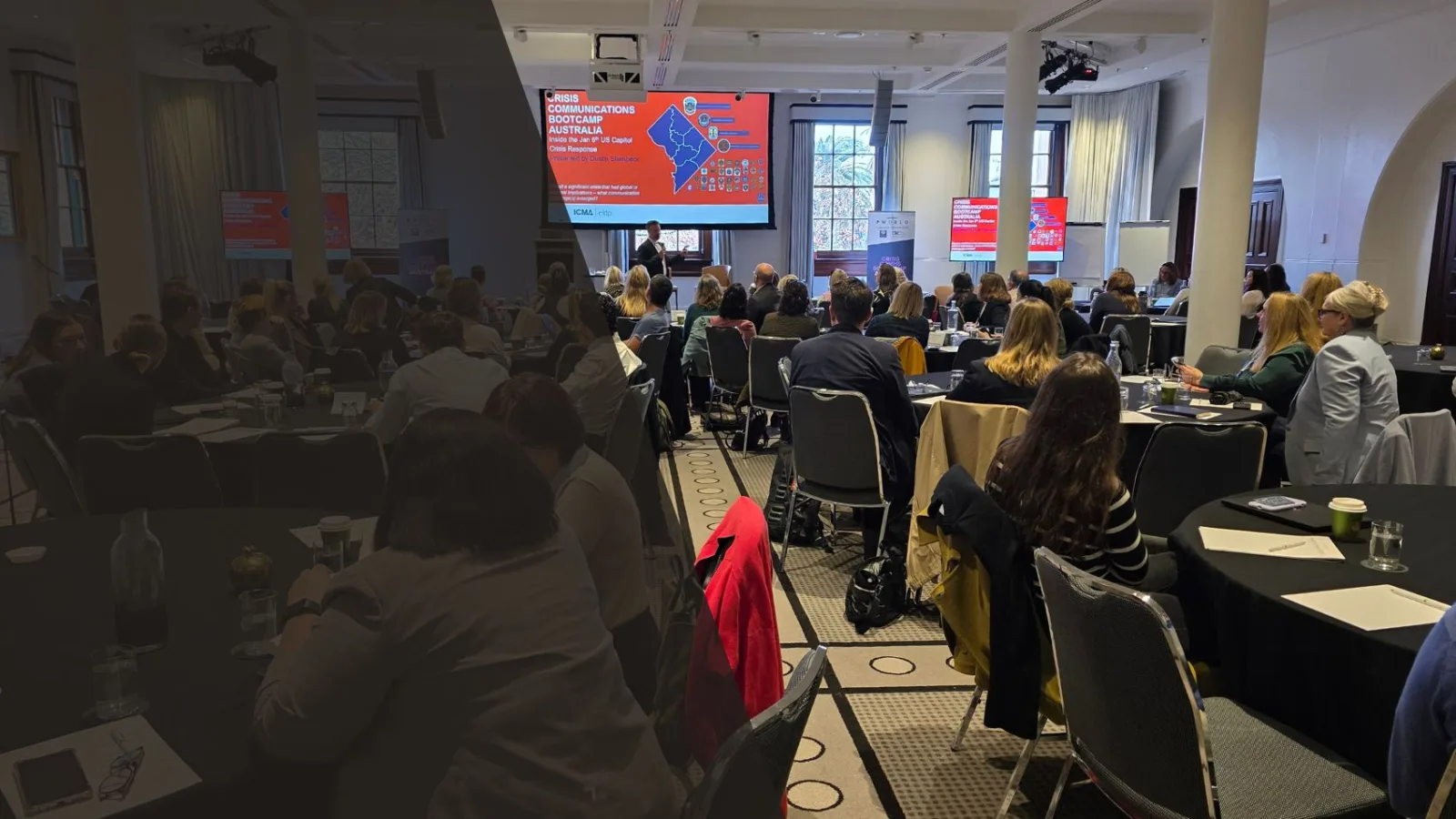
Over two days, delegates moved between case studies pulled from 10 Downing Street, the January 6 Capitol attack, the British Royal Household, and homegrown crises at EnergyAustralia, Jetstar Group and Dubai Airports. The throughline across nearly every session: trust is fragmenting, AI is rewriting the rules of detection and response, and the communicators who win are the ones who've already done the thinking before the crisis hits.
Permacrisis Is the New Normal
EnergyAustralia's Chief Corporate Affairs and Sustainability Officer Nicole McKechnie opened proceedings by naming the condition most in the room are already living: "permacrisis," an extended period of instability rather than a single discrete event. Citing the Edelman Trust Barometer's 2025–2026 findings — trust in business, government, media and employers all ticking upward in Australia, with "my employer" remaining the most trusted institution by a wide margin — McKechnie argued reputation work can no longer sit apart from day-to-day operations. Citing Will Rogers' old line that reputation takes a lifetime to build and a minute to lose, she walked through EnergyAustralia's approach to building channels, getting employees bought in as advocates, and treating crisis and business continuity planning as the same discipline, not two separate plans gathering dust in different drawers.
Internal Comms as the First Line of Defence
A recurring theme across Day One was the underrated power of internal communications. Dustin Sternbeck, former Director of Communications for the Metropolitan Police Department of the District of Columbia and now with the City of Denton, gave a rare inside account of January 6, 2021 — describing how disciplined, trusted internal messaging kept officers and leadership coordinated as the situation escalated by the minute and information stayed incomplete. His takeaway for the room: internal comms isn't a support function in a crisis, it's an operational one.
That theme carried into a fireside chat with Jetstar Group's Ingrid Just, moderated by CRC Public Relations' Lyall Mercer, on why internal communications has become the first line of defence against rumor and misalignment in an era of employee activism and demand for transparency.
The Panel: What It Actually Takes to Stay Credible
Lunch gave way to one of the day's most wide-ranging conversations: a panel on the top skills crisis communicators need in an age of polarization and uncertainty. Barbara Pesel, Managing Director of Pesel & Carr and Chair of IABC Asia Pacific, was joined by David Imber of David Imber Advisory, Adrian Cropley OAM, co-founder of the Centre for Strategic Communication Excellence, Lucas Baird of The Australian Financial Review, and Anna Brown OAM, founding CEO of Equality Australia.
With a practising journalist on the panel alongside in-house and advisory leaders, the conversation moved past frameworks into the harder trade-offs: how to balance speed against accuracy when a story is still developing, how to advise executives through genuine ambiguity rather than false certainty, and how to hold stakeholder empathy without compromising the organization's position. Panellists also tackled the increasingly common challenge of navigating social, political and cultural fault lines in real time — territory where, as Baird's presence underscored, the comms team's read of a situation and the newsroom's read of it don't always match. The session was less a list of competencies than a reminder that judgment under pressure is the one skill no amount of AI tooling can substitute for.
When the Walls Fell: Dubai Airports and the Speed of Operations
Few sessions landed harder than Desiree Schmucker's walkthrough of how Dubai Airports managed real-time crisis communications at scale when disruption brought one of the world's busiest airports to a standstill. Balancing speed, accuracy and trust across millions of passengers, global media and internal teams in real time, Schmucker's session was a reminder that in operational crises, the comms team isn't reporting on the response — it is the response.
Deepfakes, Disinformation and the Death of "Seeing Is Believing"
Edelman's Jaskirat Singh Bawa took the room inside the mechanics of AI-fuelled disinformation campaigns — how they're built, amplified and weaponized against organizations and individual leaders. With false narratives now capable of outrunning facts within minutes, Bawa walked through the early warning signals that precede a false narrative taking hold and the monitoring, verification and rapid-response protocols needed to contain damage before it compounds. The unspoken consensus in the room: deepfakes have moved from hypothetical to operational risk.
Measurement Grows Up
If Day One had a quiet revolution, it was in measurement. Nicole Moreo, formerly of LinkedIn's Marketing Science & Technology team, pushed delegates past "so what" reporting — tallying campaign results — toward "now what" thinking, where data drives real-time optimization and future strategy. Her framework reframed crisis measurement around behaviors, actions and perceptions rather than reach and impressions, introduced an "Audience Math" model built on the 95:5 rule (5% of any audience is in-market now; the other 95% is forming impressions for later), and flagged a shift already reshaping the discipline: more audiences are now meeting brands through AI summaries and zero-click search results before they ever reach owned content. Her biggest-mistakes list — waiting until a crisis hits to think about measurement, siloing crisis analysis away from always-on tracking, forgetting to benchmark, ignoring secondary audiences — drew visible nods across the room.
Behind Palace Doors
Day One closed with the session delegates had circled in advance: Colleen Harris, former Press Secretary to King Charles III, William and Harry, speaking in Australia for the first time. In a wide-ranging fireside chat, Harris offered a rare look at reputation management inside one of the world's most scrutinized institutions — anchoring a global brand in consistency and values through decades of intense media attention, and making disciplined communication calls when, as she put it, every word carries weight.
Day Two: Building the AI-Powered Crisis Plan
Day Two shifted from case study to construction site. Peter Heneghan, former Deputy Director of Digital Communications at 10 Downing Street, led a capped, hands-on workshop — limited to 80 participants — taking delegates from the fundamentals of AI and machine learning through to a live crisis simulation. Heneghan didn't shy away from the discipline's anxieties: "The AI Baggage Check" exercise had the room naming what feels uncertain, what's making people uneasy, and what they might be underestimating before any tools were introduced.
From there, the workshop got tactical. Heneghan mapped the "Communications AI Tool Cheat Sheet" — content creation, media training, video avatars, social listening, infographics and data analysis — and introduced a maturity ladder for AI use: from lazy, one-off prompting, to "Smart Prompting" with built-in context and role-briefing, to agentic AI that monitors channels and drafts response plans autonomously. He was equally candid about AI's tells: the "Al-Sounding Phrases" slide — "in today's rapidly changing world," "a game-changer for," "unlock the full potential of" — drew knowing laughs, alongside his observation that AI writing tends to tie every thread up neatly, while human writers leave the loose ends that readers actually remember. Delegates left with a working, AI-enhanced crisis plan built around their own organization's risks, not a theoretical framework to shelve.
The Takeaway
Two days, a dozen-plus speakers, and one consistent message: the fundamentals of crisis communications — storytelling, trust, relevance — haven't changed. What's changed is the speed, the audience math, and the tools available to both attackers and defenders. For the senior comms leaders who filled the InterContinental Sydney last week, the Boot Camp's value wasn't theoretical inspiration — it was a working plan to take back to the office, in a region of the world long overdue this kind of forum.
P World's next event in Australia is the Certified AI in Communications Boot Camp, taking place 12-13 November in Sydney.