
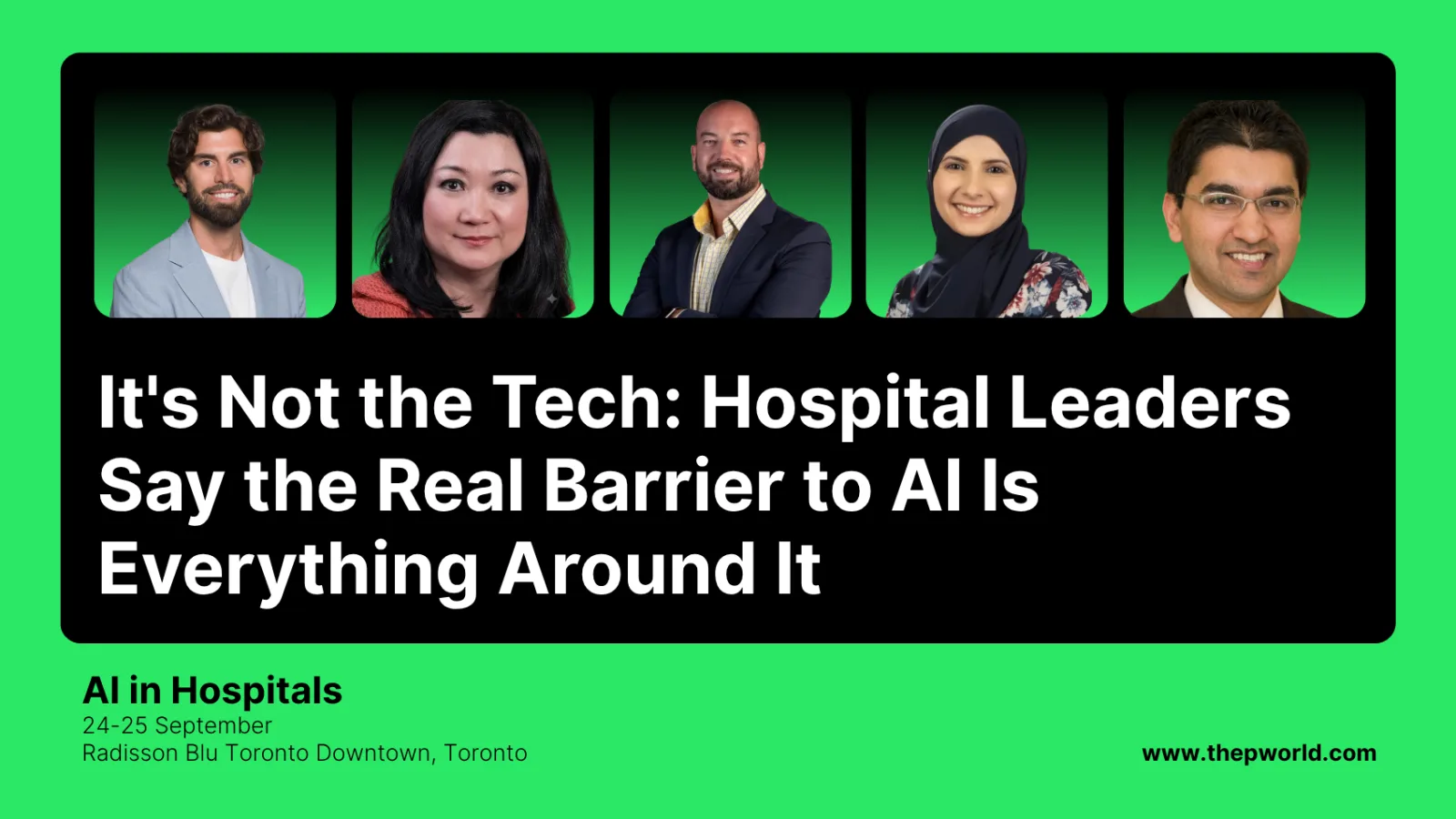
Ahead of AI in Hospitals: From Hype to Implementation, running 24–25 September at the Radisson Blu Toronto Downtown, we put that question to speakers from this year's program. Their answers were strikingly consistent — and they all pointed away from the technology itself.
"The biggest obstacle to AI adoption in hospitals isn't the technology—it's the gap between possibility and organizational readiness," said Zach Kilburn, Chief Digital Officer at Horizon Health Network. "We already have AI capable of delivering meaningful value in clinical and operational settings, but success depends on trust, governance, data quality, workflow integration, and leadership commitment. Too often, organizations focus on the tool and underestimate the change required around it. AI implementation is ultimately a people, process, and culture challenge. The hospitals that will lead the next decade aren't necessarily those with the most advanced technology—they're the ones that can build the confidence, capability, and governance needed to use it at scale."
Kathy Malas, Chief Quality, Innovation, Artificial Intelligence and Value Officer and Director of OROT at the University Health and Social Services Integrated Center of West Central of Montreal, framed it as a capacity problem rather than a technical one.
"The biggest obstacle to AI adoption in hospitals is not the technology—it is our capacity to transform around it," Malas said. "AI creates value only when it addresses a real clinical or operational need, is integrated seamless into workflows, earns the trust of patients and teams, and is supported by strong governance, data, leadership, and change management. The real challenge is moving beyond pilots to redesigning how care is delivered and how people work. Successful adoption is therefore not simply a technology project; it is a human-centred organizational transformation—built by, with, and for the people delivering and receiving care."
For Kevin Bernard, National Leader, Integrated Health Solutions at Medtronic Canada, the missing ingredient is expertise and bandwidth.
"The biggest barrier to AI adoption in hospitals is not the technology itself, but the capacity and expertise needed to implement it effectively," Bernard said. "Resource constraints, limited change bandwidth, and a lack of AI understanding often create resistance. Success depends as much on change management as technology, requiring strong governance, implementation support, and stakeholder engagement. Teams such as Medtronic's CarePath IQ™ can act as an enablement partner helping hospitals move beyond pilots and realize AI's full enterprise-wide value."
His colleague Maisie Cheung, Senior Director of Strategic Marketing & Commercial Innovation at Medtronic Canada, sees a related but distinct issue: hospitals adopting AI into systems that are already fragmented.
"The challenge with AI in healthcare isn't a lack of innovation. It's that we're often adding intelligent tools into fragmented systems," Cheung said. "Hospitals can end up with more algorithms, more dashboards, and more insights, yet patients still experience disconnected care. The organizations that succeed won't be those with the most AI. They'll be the ones that connect AI across workflows, departments, and the patient journey to create a truly intelligent healthcare system."
Nihal Haque MD FRCPC, Assistant Professor (part-time) in the Department of Medicine at the University of Toronto, brought the argument down to the floor of the clinic, where even small friction gets multiplied at scale.
"The biggest obstacle to AI adoption in hospitals is workflow. This is not any different from non-AI technology adoption," Haque said. "Clinical medicine is a highly regulated and regimented field. Any slight deviation from standard practices can cause resistance to adoption due to increased time needed to achieve a particular task. Multiply that by the number of patients seen everyday and pretty soon an AI technology may be good in theory but not as helpful in practice. The key here is to critically examine the workflow and determine how the AI technology can fit best into it and not the other way around."
Taken together, the message from this year's speaker lineup is hard to miss: nobody is arguing that hospitals need better algorithms. They're arguing that hospitals need better readiness — governance, trust, workflow design, and the organizational muscle to change how people actually work. The technology, in other words, was never really the hard part.
That's the conversation AI in Hospitals: From Hype to Implementation is built around. The two-day conference brings together 16 speakers from organizations including Health Canada, the Canadian Institute for Health Information, Alberta Health Services, Humber River Health, Hamilton Health Sciences, Unity Health, the Mount Sinai Health System, Island Health, North York General Hospital, Trillium Health Partners, and the Jewish General Hospital in Montreal, running 24–25 September 2026 at the Radisson Blu Toronto Downtown.
Full agenda and registration: https://www.thepworld.com/event/ai-in-hospitals-from-hype-to-implementation
Partners
Platinum Sponsor: Medtronic Canada
Exclusive Media Partner: Canadian Healthcare Technology
Supported by: CAN Health Network